
THE COMPLETE GUIDE · SPAIN FOR FILIPINOS
Every Legal Way Into Spain.
One Advantage Only Filipinos Get.
Retiree, remote worker, student, teacher, or working professional, there's a route to Spain built for your situation. And for Filipinos specifically, every one of them can lead somewhere most nationalities don't get: Spanish citizenship in two years instead of ten.
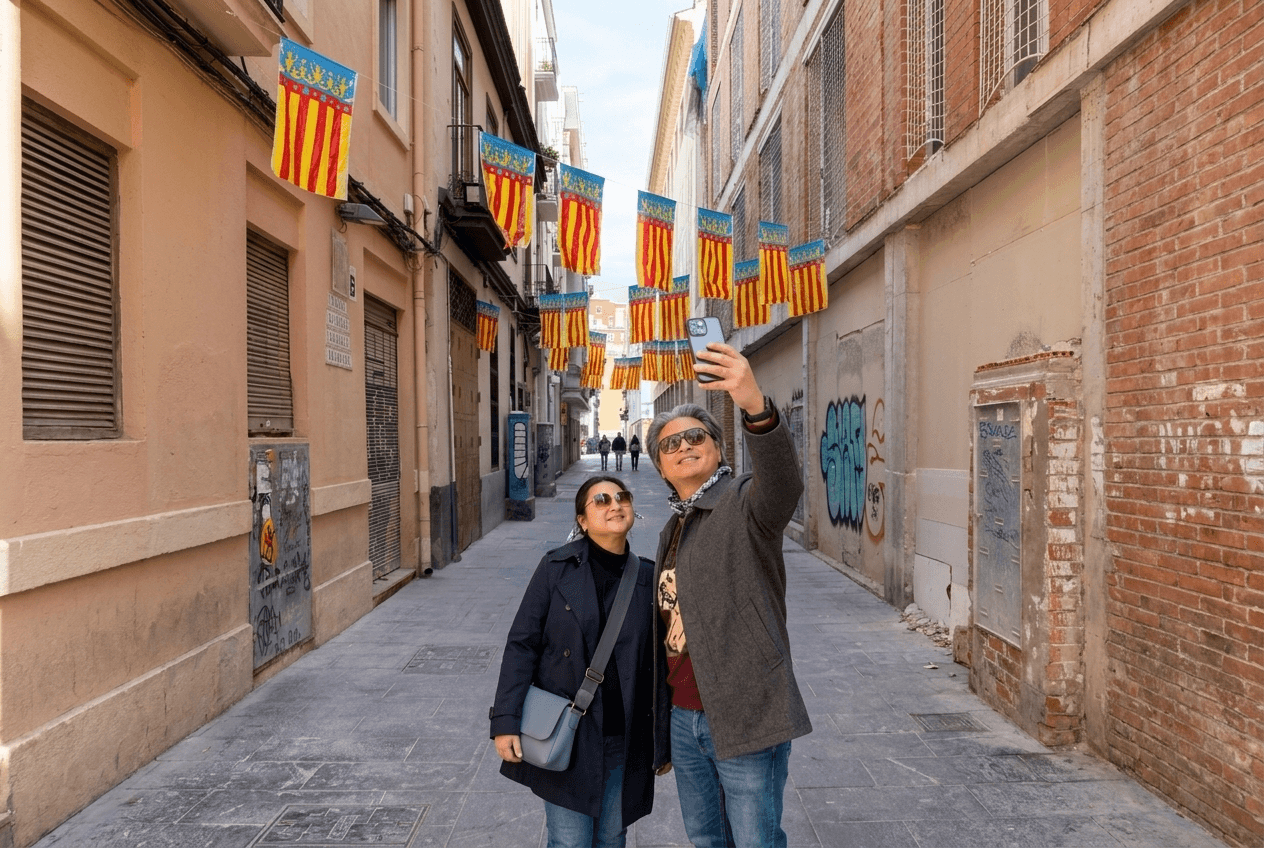
We're Paul and Bea. We sold everything, packed six suitcases and a dog, and moved from Southern California to Valencia without ever having set foot in Europe. We used the Non-Lucrative Visa to get here. Two years later, we were Spanish citizens, and we didn't have to give up our Philippine passports to do it.
This page is the map. Five real paths into Spain, what each one actually requires, and where the two-year citizenship clock does and doesn't apply.

WHY THIS PAGE EXISTS
Why We Built This
Every week, someone messages us asking which visa fits them. A retired aunt with a pension. A cousin who freelances for a US company. A nephew wanting to study. A friend with a teaching certificate. A colleague with a job offer from a Spanish company. They're all asking a version of the same question: is there a way in for me?
There is, for almost everyone. We put every path in one place so families can actually compare them, instead of piecing it together from comment sections.

THE FILIPINO ADVANTAGE
The Part That's True No Matter Which Path You Choose
Most nationalities need ten years of legal residency in Spain before they're eligible to apply for citizenship. Filipinos need two. It's written into Article 22 of Spain's Civil Code, which recognizes the Philippines alongside a small group of countries with historic ties to Spain.
There's a second piece that matters just as much: Spain normally requires new citizens to renounce their original nationality. The Philippines is exempted from that under Article 24, so Spanish citizenship doesn't cost you your Philippine passport. Republic Act 9225 on the Philippine side lets Filipinos who've naturalized elsewhere reacquire Philippine citizenship too, so this genuinely runs both directions.
Here's the detail that matters when you're comparing the five paths below: the two-year clock only runs while you hold a residence permit, not while you're on a student stay. The Non-Lucrative Visa, the Digital Nomad Visa, and the Highly Qualified Professional permit are all residence permits, so time on any of them counts from day one. A student visa is classified differently under Spanish law. It's a valid and common way to build toward a residence permit, but the years themselves don't advance the citizenship clock until you've converted into one.
We used the NLV ourselves and became citizens on schedule. For the specifics of your situation, especially if a student or teaching path is part of your plan, this is worth confirming directly with [Bureaucracy.es], the immigration team we've worked with longest.
We recorded two videos that go deeper into the Filipino citizenship path specifically:
THE FIVE WAYS IN
Five Paths. Pick the One That Fits Your Life.
A short summary of each, with the full breakdown linked where we've written one.
Best for: retirees, early retirees, anyone living off savings, a pension, or passive income who doesn't need to work in Spain. Core ask: proof of financial means (currently around €29,000 solo / €36,000 for a couple), private health insurance, a clean criminal record. Counts toward citizenship: yes, from day one. → [Read the Full NLV Guide]
Best for: remote employees, freelancers, and business owners whose income comes from outside Spain. Core ask: 100% remote work, stable income around €2,800/month solo (adjusted yearly), a clean criminal record covering the last two years. Counts toward citizenship: yes, from day one.
Best for: anyone pursuing a degree, language program, or certification in Spain, including a first step before switching to a work-based path. Core ask: acceptance from an accredited institution, proof of financial means (roughly €600/month based on Spain's IPREM index), full health insurance with no co-payments. Counts toward citizenship: not directly. Study years are a foundation, not the clock itself. See below.
Best for: certified or soon-to-be-certified English teachers who want a structured route in, often starting on a student visa while completing a teaching certification. Core ask: a recognized teaching certification (like the Trinity CertTESOL), enrollment in an accredited program, the same financial and insurance proof as the student visa while studying. Counts toward citizenship: not while on the student portion. Once you're hired and switch to a work permit, the clock starts.
See below. → [More on the Teaching Path]
Best for: professionals with a job offer from a Spanish employer in a managerial, technical, or specialized role. Core ask: a qualifying job offer, a minimum salary (roughly €40,000/year for technical and scientific roles, €54,000/year for managerial roles in 2026), a university degree or several years of relevant experience. Counts toward citizenship:
yes, from day one. → [More on the HQP Visa]
The Student Visa, in Detail
Spain's student visa (Visado de Estudios) is for anyone accepted into a recognized program, a university degree, a language course, a certification, or specialized training, for longer than 90 days.
What you'll need:
Acceptance from an accredited institution
Proof of financial means, around €600/month for the length of your stay, based on Spain's IPREM index
Full private health insurance, no co-payments, no deductibles, minimum €30,000 in coverage
A clean criminal record if you're staying more than six months
What it opens up: Students can currently work up to 30 hours per week alongside their studies, provided the work doesn't interfere with the program. After finishing, many convert into a 12-month job-search permit, or directly into a work-based permit if they already have an offer.
The honest part about citizenship: Time on a student visa does not count toward the two-year citizenship clock. It's classified as a stay, not legal residence, under Spanish law. What it does is put you inside Spain, building a network, learning the language, and positioning yourself for the residence permit that actually starts the clock, whether that's a job offer, an HQP conversion, or another route.
This is one of the areas where getting matched with the right program from the start makes a real difference. We work with Courtney April at Study in Valencia, who specializes in exactly this pathway. → [Learn More About Study in Valencia]

Teaching in Spain, in Detail
Teaching English is one of the most common ways Filipinos build a real, structured life in Spain, and it usually starts with the same student visa described above, just with a specific goal: a recognized teaching certification.
What it typically looks like:
Enroll in an accredited program, such as the Trinity CertTESOL
Come in on a student visa while you complete the certification
Use the certification and your time in Spain to find work at a language academy or school
Convert into a work-based permit once you're hired
What it opens up: A recognized certification is taken seriously by Spanish language academies, and having lived in the country during your training is a real advantage when you start applying. Once you're hired and your status changes to a work permit, that's when the years start counting toward the two-year Filipino citizenship track, not before.
We work with Tita Ashton at EBC Servicios Lingüísticos / Road2Spain, who runs the Trinity CertTESOL program most of our audience asks about. → [Learn More About EBC Servicios Lingüísticos]

The Highly Qualified Professional Visa, in Detail
If you already have, or can realistically get, a job offer from a Spanish company in a managerial, technical, or specialized role, the HQP visa is usually the fastest and most direct route into Spain.
What you'll need:
A job offer from a Spanish employer for a role that qualifies as managerial, technical, or highly specialized
A university degree, or several years of directly relevant professional experience
A minimum salary that Spain sets annually. For 2026, that's roughly €40,000/year for technical and scientific roles and €54,000/year for managerial and executive roles, with some reductions available for applicants under 30
A clean criminal record and valid health insurance
Why it's different from the others on this page: The HQP visa is employer-sponsored. It exists specifically so Spanish companies can hire skilled non-EU professionals faster than the standard work permit process allows, filed through a dedicated government unit with a 20-business-day target for processing.
What it opens up: Family members can apply alongside you. Time on the HQP counts toward the two-year Filipino citizenship track from day one, the same as the NLV and DNV, since it's a genuine residence permit rather than a stay.
This is a route where getting the case built correctly from the start matters more than most, since it's reviewed as a full package: role, salary, qualifications, and employer documentation together. → Learn more about the Highly Qualified Professional Visa (HQP)

WHICH PATH FITS YOU
A Quick Way to Narrow It Down
If you're still not sure which of the five applies to you, work through these in order:
1. Do you already have a job offer from a Spanish company in a skilled or managerial role? Look at the HQP visa.
2. Can you work fully remotely for a company or clients outside Spain? Look at the DNV.
3. Do you have savings, a pension, or passive income and don't need to work at all? Look at the NLV.
4. Are you coming to study a degree, language, or certification first? Look at the Student Visa, and if teaching is the goal, the Teaching pathway specifically.
5. Not sure which category you fall into, or fall into more than one? That's normal, and it's exactly what a consultation with [Bureaucracy.es] is for.
GETTING SETTLED AFTER YOU LAND
Whichever Path You Choose, You'll Still Need These
Health insurance. Every path on this page requires private health insurance with no co-payments. We use InnoInsure ourselves and send our audience there since their policies are built around what Spanish consulates expect.
→ [Learn more about visa health insurance options]
Housing. Whether you're renting first or planning to buy, foreign mortgages work differently than what you're used to. We recorded a conversation with Mirelle at The Spanish Nest on exactly this.
→ [Learn more about properties in Spain]
Coordinating everything at once. If the idea of doing all of this alone, in a new country, in a language you don't speak yet, feels like a lot, our Valencia relocation service handles the on-the-ground setup.
Already Deciding Where to Land?
Once you know your path in, the next question is usually where in Spain to actually settle. Our guides cover exactly that:
Spain City Guide: 50 cities across four categories
Apartment Hunting Guide: finding and securing a place as a foreigner
Timeline and Checklist: the order of operations for the move itself
STILL HAVE QUESTIONS?
We answer NLV, DNV, Student and Teaching English in Spain visaquestions on their own dedicated pages. If your question is about the bigger picture, comparing paths, the citizenship timeline, or something specific to your situation, message us on Facebook or Instagram with the keyword VISAS, and our ManyChat system will route you to the right resources.
→ [Read the NLV Questions We Get Asked Most]
→ [Read the Digital Nomad Visa Questions We Get Asked Most]
→ [Read the Studying in Valencia Questions We Get Asked Most]
→ [Read the Teaching English in Spain Questions We Get Asked Most]

Helping everyone move to Spain — with courses, consultation, and real first-hand experience from Valencia.



Join our newsletter
© 2026 Everything is Boffo. All rights reserved.
*Some links may be affiliate links. Using them helps support us at no extra cost to you.
Some links on this page connect to businesses we've worked with directly. We may earn a referral fee if you choose to work with them, at no extra cost to you. We only recommend people and companies we've used ourselves.
Access the Spain for Filipinos: The Complete Guide to Every Visa Path
Enter your email below to access this free guide. If you're new here,
you'll also receive the FREE Spain Starter Kit!
No spam. Just practical guidance to help you move forward.