


A PATH TO SPAIN THAT DOESN'T REQUIRE A REMOTE JOB

Teach English in Spain: Here's the Real Process

We sat down with the founder of EBC and asked her everything. This page has every answer in one place: the certification, the visa, the cost, and how to apply before the next intake fills up.

  • Trinity College London accredited

  • Recognized by the British Council

  • Recognized in 100+ countries

WATCH FIRST

We Sat Down With the Founder and Asked Everything

This is the full conversation with Tita Ashton, founder of EBC, the school behind the Trinity CertTESOL certification. If you've already watched it on our channel, skip down to the questions below.

WHY THIS PAGE EXISTS

The same questions, answered once

We get the same questions over and over after that video goes out. Is the certification real. What it costs. Whether you need to already speak Spanish. Whether this actually leads to a visa.

So instead of answering the same message for the hundredth time, we put it all on one page, pulled straight from our actual conversation with Tita. If you read through this and still have a question, you'll know it's a genuine one, not something we already covered.

THE PROBLEM THIS SOLVES

If you've looked into moving to
Spain, you've probably run into one of these problems

The Non-Lucrative Visa needs proof of savings or passive income most people don't have

The Digital Nomad Visa needs a remote job that pays in a foreign currency, which most people also don't have

Citizenship by descent doesn't apply to everyone

"Just find a job in Spain first" sounds simple until you're applying for jobs that need a work permit you don't have yet

A student visa tied to a real certification and a real program is one of the few legal routes that doesn't require any of the above. It just requires you to actually go and study.

GET THE FREE SPAIN STARTER KIT

Not Sure Which Path Fits Yet? Start Here.

Before you go through what happens next, grab the newly updated Spain Starter Kit. It's the same free guide we send anyone who's serious about making this move, built from what we wish we'd had before we packed our own six suitcases.

What's inside:

  • The basics of moving to Spain from the US, Canada, or the Philippines, explained plainly

  • A first-look comparison of the visa paths, so you're not starting from zero

  • The questions to ask yourself before you commit to a path

No spam. Just the guide, and updates on visas, citizenship, and life in Spain.

THE PATH WE POINT PEOPLE TO

The Trinity CertTESOL, and
what it
actually gets you

There are only two English teaching certifications accepted by the British Council across its network of 170+ teaching centers in 40+ countries: CELTA and Trinity CertTESOL. EBC's course is the second one. In Tita's words, holding it "guarantees you a lot of job opportunities," and it's regulated by Ofqual at Level 5, the same level as the first year of a university degree, with up to 60 transferable university credits attached.

TEFL

is Teaching English as a Foreign Language. That's what you do when your students' first language isn't English. "In Spain, if you want to teach in Spain, you TEFL," she told us, "because obviously in Spain they have Spanish as their first language."

TESOL

is Teaching English to Speakers of Other Languages. That's teaching non-native speakers inside an English-speaking country: the US, the UK, Canada.

The Trinity CertTESOL gives you both certifications from one course, so you're covered whether you teach in Spain, somewhere else, or come home and teach there instead.

One thing that surprised us:

Native English speakers still have to apply and interview. Tita told us people ask her this constantly: "I'm a native English speaker, why should I do your admission testing?" Her answer is the same every time: "You speak the language, but can you teach the language?" During interviews, she'll sometimes offer a quick test on the spot, two sentences that are both grammatically correct but mean something different. If you can explain the difference instantly, great. If you have to pause, that's exactly the gap this course closes. (She walks through the actual example in our video, around the 21-minute mark.)

What makes this different from the cheap online certificates

(the ones Tita calls "cowboy courses"):

  • 200 total hours, including 80 hours of live, interactive training, not pre-recorded lectures. British Council recognition requires a minimum of 150 hours; she told us the cheaper courses typically run around 120

  • "The sad part is we've seen it time and time again," Tita said. People take the 120-hour course, get turned down by a language school for not having a recognized certificate, then come back and pay for a real one. "Effectively, you pay twice"

  • Real teaching practice, not just theory. You teach actual students, five to ten per session, on Thursday and Friday across the first three weeks, with a tutor watching and grading you

  • A trainer-to-trainee ratio of 6 to 1

  • The course wraps with a language exam on the last Tuesday and external moderation on the last Friday, where a Trinity-appointed assessor reviews your coursework, observes a class, and interviews you directly

  • Your certificate doesn't say "online" anywhere on it. It's identical to the in-person version

HOW THE FULL PROGRAM WORKS

If You Want the Visa Too:

How Road2Spain Works

1

Home

Financial proof. You need to show the consulate you can support yourself in Spain. Here's the part people get wrong: you can't list your future teaching income as that proof. As Tita put it, the right to work up to 30 hours a week "is not an obligation of the Spanish government, it's a perk." You can't tell the consulate you'll be earning €1,500 to €1,800 a month and lean on that; you need separate financial documentation.

2

Choose

Choose your enrollment track You pick a postgraduate specialization: Brand Management, International Communications, or Logistics. This enrollment is what makes you eligible for the student visa. An online-only certificate won't get you one; the consulate needs proof of a real, in-person program in Spain with confirmed dates.

3

Apply

Apply for your visa from home With your enrollment letter from EBC stating your exact start and end dates, you apply for a one-year Spanish student visa at your home country's consulate. Five documents come up in every application:

  • Financial proof. You need to show the consulate you can support yourself in Spain. Here's the part people get wrong: you can't list your future teaching income as that proof. As Tita put it, the right to work up to 30 hours a week "is not an obligation of the Spanish government, it's a perk." You can't tell the consulate you'll be earning €1,500 to €1,800 a month and lean on that; you need separate financial documentation.

  • Private medical insurance, recognized by hospitals in Spain, including repatriation coverage.

  • A clean national criminal background check (an FBI report for US applicants, an NBI clearance for Filipino applicants). Tita didn't soften this one: "If you have even just one DUI, I won't bother applying. They're very strict with this."

  • A medical certificate from a doctor or hospital confirming you're in good health.

  • The letter of invitation from EBC, confirming your specific enrollment dates. This is the document that actually unlocks the visa.

4

Land

Land and start your routine A typical day, the way Tita walked us through it:

  • 9:00–12:00 Spanish language classes

  • 1:30–6:00 teaching English, mostly corporate clients (banks, consulting firms)

  • 6:30–8:30 postgraduate coursework, in person and online

The 30-hour weekly cap on the visa is the reason the teaching block is sized the way it is, not a school scheduling choice.

Already have a legal way to live in Spain?

If you're an EU citizen, already have residency, or qualify another way (a number of our Filipino audience will get there through the separate two-year naturalization pathway under Spanish law), you may not need the visa bundle. You can take just the Trinity CertTESOL on its own and start applying to schools once you're already in the country legally.

WHAT IT COSTS

Pricing, Straight Up

We're not going to make you book a call just to find out the number.

Trinity CertTESOL on its own

(no visa, no enrollment program):

€1,450 — four weeks online, 200 hours total, dual TEFL + TESOL certification, certificate shipped to you, lifetime job placement support included

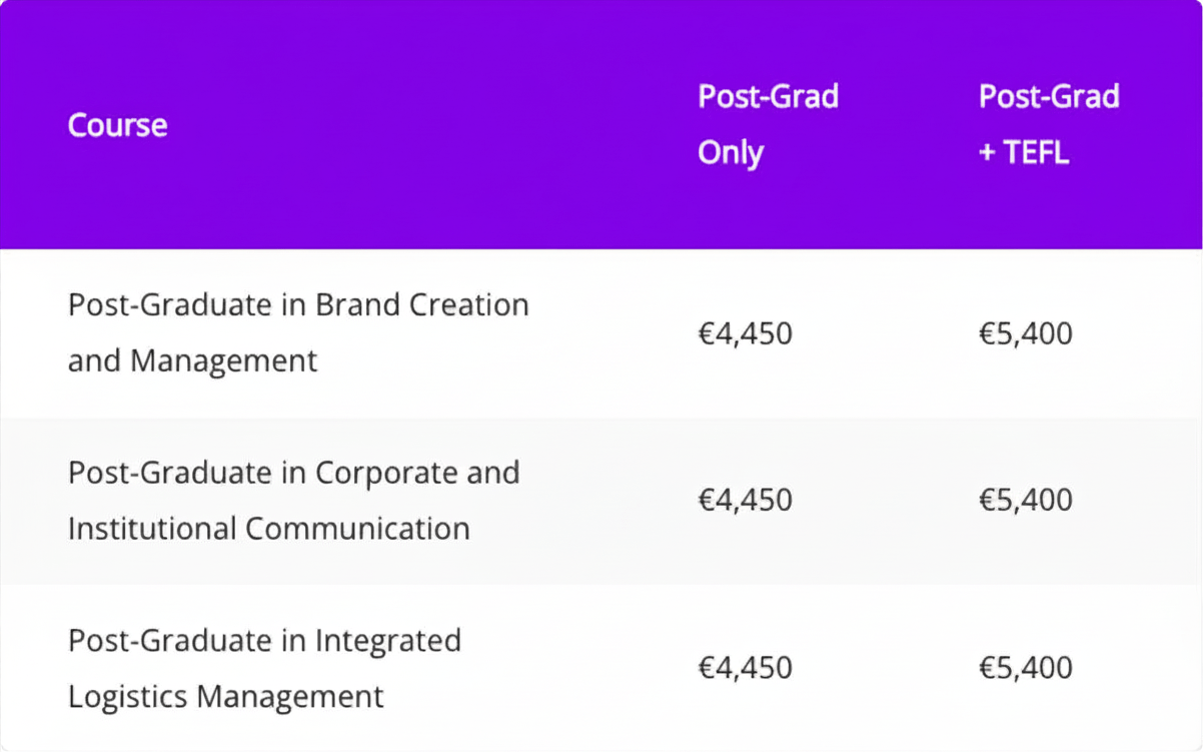
A quick note on the numbers: When we recorded the interview, Tita quoted €5,400 for the EBC Road2Spain Postgraduate + TEFL package, which includes the Trinity CertTESOL qualification. She also mentioned €4,450 for the postgraduate programme only (without the Trinity CertTESOL).

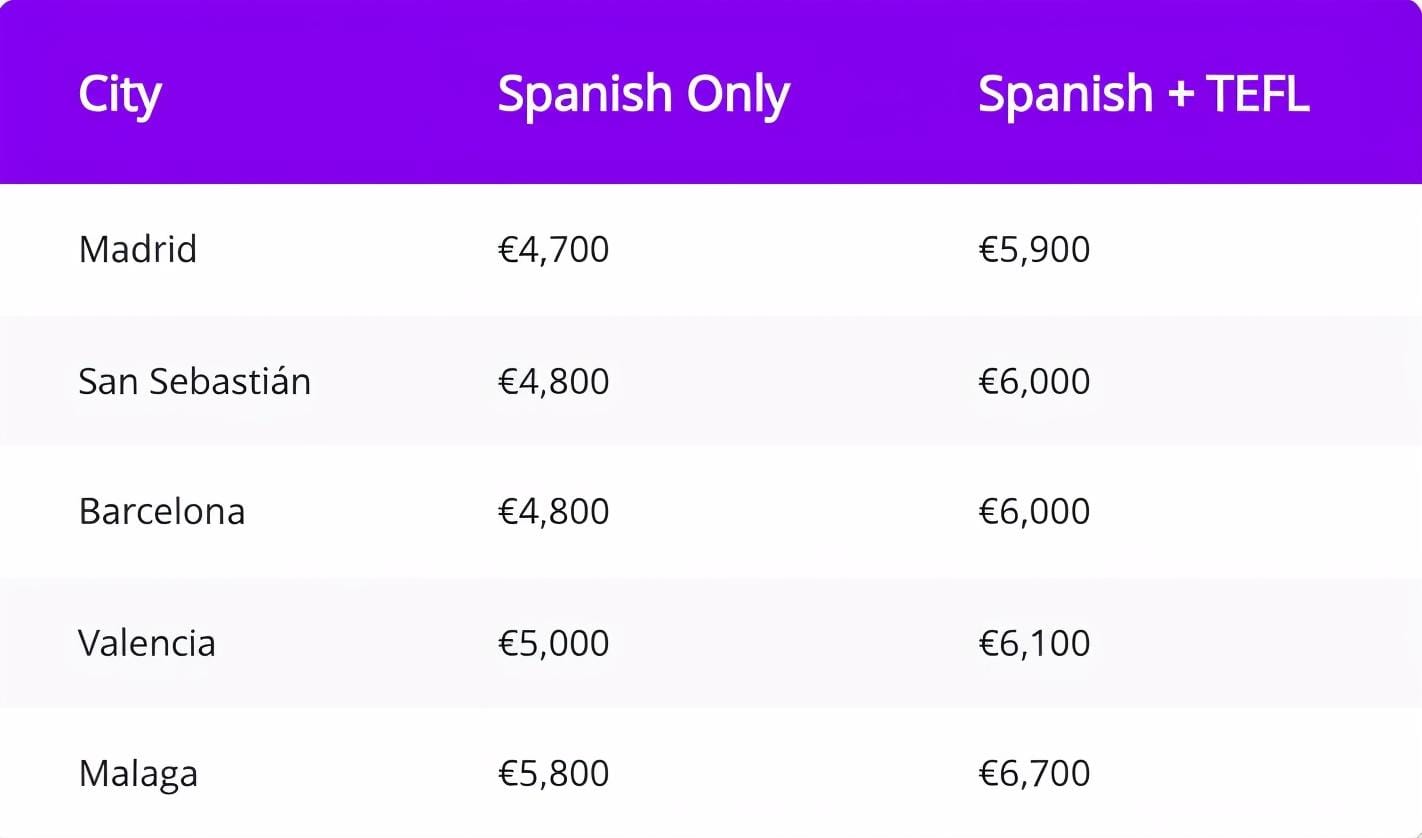
EBC also offers a one-year Spanish language programme, with fees that vary depending on the city you choose. However, as discussed in the interview, not all Spanish language programmes allow you to work legally in Spain. For those whose goal is to study and obtain work authorisation, the postgraduate programme is generally the more suitable option.

WHO THIS IS ACTUALLY FOR

Tita told us their students run from 18 (the minimum age) to people well into their late sixties.

"We have a lot of returners to work," she said: people with strong professional backgrounds who are retired and want a second act, not a wind-down. The most memorable one she mentioned was a former managing director at a petroleum company, British, who took the course at 68. "He loved it," she said twice.

The people who tend to do well with this:

  • Career changers who want a real reset, not just a vacation

  • People without a remote income who still want a legal way to live in Spain

  • Filipino diaspora and OFWs looking for a route into Europe that doesn't depend on a sponsor or a passive income requirement

  • Retirees and "returners to work" with professional experience they want to use again, just differently

  • Anyone drawn to teaching, even without past classroom experience. No teaching background is required to start

FAQ

QUESTIONS WE GET ASKED

Is this certificate actually recognized, or is it one of those courses nobody respects?

It's accredited by Trinity College London (examining over 850,000 people across 60+ countries every year) and recognized by the British Council, one of only two TEFL/TESOL certifications that are. You can check the accreditation directly on the UK government's Ofqual register.

Do I need teaching experience or a specific degree?

You don't need teaching experience. You do need to be 18 or older by the course start date, have a high level of English across listening, speaking, reading, and writing (native or non-native, as long as it's strong), and have completed secondary education with a qualification to enter higher education.

I'm a native English speaker. Why would I need a certification at all?

Tita gets this question often, and her answer is consistent: "You speak the language, but can you teach the language?" Speaking English fluently doesn't mean you can explain a grammar point clearly, plan a lesson, or manage a room of students who learn at different speeds. That gap is what the course is built to close, for native and non-native speakers alike.

How much can I realistically earn teaching English in Spain?

EBC's published range is €1,200 to €2,000 a month, with private hourly rates around €15 to €20. Pay tends to run higher in Madrid and Barcelona than in smaller cities.

Do I need to speak Spanish first?

Lorem ipsum dolor sit amet, consectetur adipisicing elit. Autem dolore, alias, numquam enim ab voluptate id quam harum ducimus cupiditate similique quisquam et deserunt, recusandae.

What does that actually look like?

One example Tita gave us directly: a graduate who arrived in Spain with zero Spanish, taught for about a year and a half while picking up the language quickly, and is now an assistant manager in the engineering department of a large company in Spain. Her words: "That's not all the time, but that could happen."

What happens if a school doesn't pay what they promised?

This actually happened to one of EBC's graduates. She was quoted €18 an hour at her interview; her paycheck came out to €16. She reported it to EBC, who called the school directly: "If you don't pay her the €2 discrepancy, you're out of our database." The school pushed back, EBC removed them, and within two weeks the school came back asking to resolve it, since without EBC's pipeline of graduates, they couldn't find qualified teachers.

Can I list my future teaching income as proof of funds for the visa?

No, and this trips a lot of people up. The right to work up to 30 hours a week on a student visa is, in Tita's words, "a perk that the Spanish government is giving you," not an entitlement you can lean on for your financial proof. You need separate documentation showing you can support yourself, independent of what you expect to earn teaching.

Will I actually find a job after I'm certified?

EBC sends your CV to its network of partner language schools worldwide (2,351 of them, by Tita's count, with over 385 of them in Madrid) and includes a spreadsheet showing exactly who received it, so you can follow up directly. She was upfront about what they can and can't promise: "I can't guarantee you a job. I'm not at the interview. What I can guarantee are interviews." Landing a job in the first week isn't unusual. Her honest benchmark: if you've gone through 50 interviews from that pipeline and still haven't landed something, it's worth rethinking your interview approach rather than the certification.

What if I'm not accepted into the course?

Not everyone gets in automatically. After you apply, you’ll get an email about scheduling your pre-admission testing, which is a roughly 25-minute spoken interview (around eight straightforward questions about your work and educational background), and you write a 200-word handwritten essay on the spot, on the topic "what makes a good teacher." The essay checks your written English; the interview checks your spoken English. Tita's note on this: "There's no right or wrong answer, it's the level of English."

How is each week of the course actually structured?

Monday through Wednesday are live input sessions covering theory and methodology. Thursday and Friday, across the first three weeks, are teaching practice: real lessons in front of five to ten genuine students, graded and observed by a tutor. The last Tuesday is a language exam, and the last Friday is external moderation, where a Trinity-appointed assessor reviews your work directly.

Will my certificate show that I trained online instead of in person?

No. The certificate is identical either way. Nothing on it distinguishes online delivery from in-person.

How is this different from a cheap $30 online TEFL certificate?

The difference is recognition, training quality, and career support. Most low-cost online TEFL certificates are around 120 hours, involve little or no real teaching practice, and aren’t accepted by the British Council network or many reputable employers.

The Trinity CertTESOL is a 200-hour, internationally recognised qualification that includes supervised teaching practice with real English language learners, not just theory. It’s one of only two TEFL qualifications accepted by British Council schools worldwide. On top of that, graduates receive lifetime, worldwide job placement assistance through EBC, giving you on going support long after you’ve completed the course.

I'm Filipino. Does this work alongside the path to Spanish citizenship?

Once you switch to a residency visa, yes. They're separate things that work fine together. Filipino nationals have access to a distinct two-year naturalization pathway under Spanish law. This program is about getting a legal visa and income now; citizenship eligibility runs on its own separate timeline.

Can I do this if I'm not planning to live in Spain long-term?

Absolutely. The Trinity CertTESOL is an internationally recognised teaching qualification, so you’re not limited to Spain. It’s accepted by reputable employers around the world, allowing you to teach wherever you’re legally able to live and work, or to teach English online from virtually anywhere.

EBC’s lifetime worldwide job placement assistance is also global, not Spain-specific. Many EBC graduates go on to teach in completely different parts of the world, while others build online teaching careers from home. EBC also sends graduates a list of online schools currently hiring from their network, so it's possible to start earning online even while your visa paperwork is still processing.

Are you getting paid for sending people to EBC?

Yes. This page contains a referral link to EBC, and we may earn a commission if you enroll through it, at no extra cost to you. We only point people toward programs we've vetted and looked into ourselves; this page is built on a direct conversation with EBC's founder, not a guess.

REMAINING 2026 INTAKES

EBC's agreement with Trinity caps each intake at 15 students.

These are the remaining start and end dates for 2026:

August 3 – August 28

September 7 – October 2

October 12 – November 6

November 16 – December 11

Live sessions run 3:00 to 7:00 PM CET each day, worth checking against your own time zone before you commit.

Once an intake's 15 spots are filled, the next available date is the one after it.

There's no waitlist magic here, just a real cap set by Trinity, so if a particular date matters to you, apply early enough to confirm it before it closes.

If You've Read This Far, You Already Know If This Is for You

You've seen the video, gone through the questions, and seen the cost and the timeline. The next step is the application itself, which EBC reviews directly.

Questions we didn't cover? Reach out to us directly and we'll point you in the right direction.

Disclaimer: This content is provided for general informational and educational purposes only and should not be considered legal, financial, tax, medical, or immigration advice. Rules, visa requirements, housing regulations, tax obligations, and public services in Spain can change frequently and may vary depending on your nationality and personal circumstances. Always verify information with official government sources or qualified professionals before making decisions. Some links, resources, courses, consultations, and recommended services mentioned throughout our content may be affiliate partnerships, meaning we may earn a commission at no additional cost to you if you choose to use them. We only share resources, professionals, and services we genuinely trust or believe may be useful to our community. Any opinions expressed are our own and based on personal experience, research, interviews, and publicly available information at the time of publication.

Support from readers who use our links, courses, or resources helps us keep this information free, maintain the platform, and quite literally keep the lights on at home so we can continue producing guides like this for the community.

Newsletter

Subscribe now to get the latest updates.