
DIGITAL NOMAD VISA · SPAIN · FOR FILIPINOS
Keep Your Job. Change Your Address.

The Digital Nomad Visa is for the version of you who doesn't have to quit anything to move. If your income already comes from a laptop, Spain has built a visa around exactly that.
We moved to Valencia on a different visa, the Non-Lucrative Visa, which meant giving up work entirely to qualify. Spain has since built a path for people who don't want to make that trade. If you work remotely for a company outside Spain, freelance for foreign clients, or run a business that doesn't depend on being in one place, this page walks through what the Digital Nomad Visa actually asks of you.
WHY THIS VISA MATTERS TO YOU
A Quick Note Before We Start

We want to be upfront: we didn't come to Spain on the Digital Nomad Visa. We used the Non-Lucrative Visa, then became Spanish citizens two years later. But this is the visa question we hear the most from people who read about our move and think, "I still have a job, so this doesn't apply to me." It does. It's likely a better fit for a large part of our audience than the one we used ourselves.
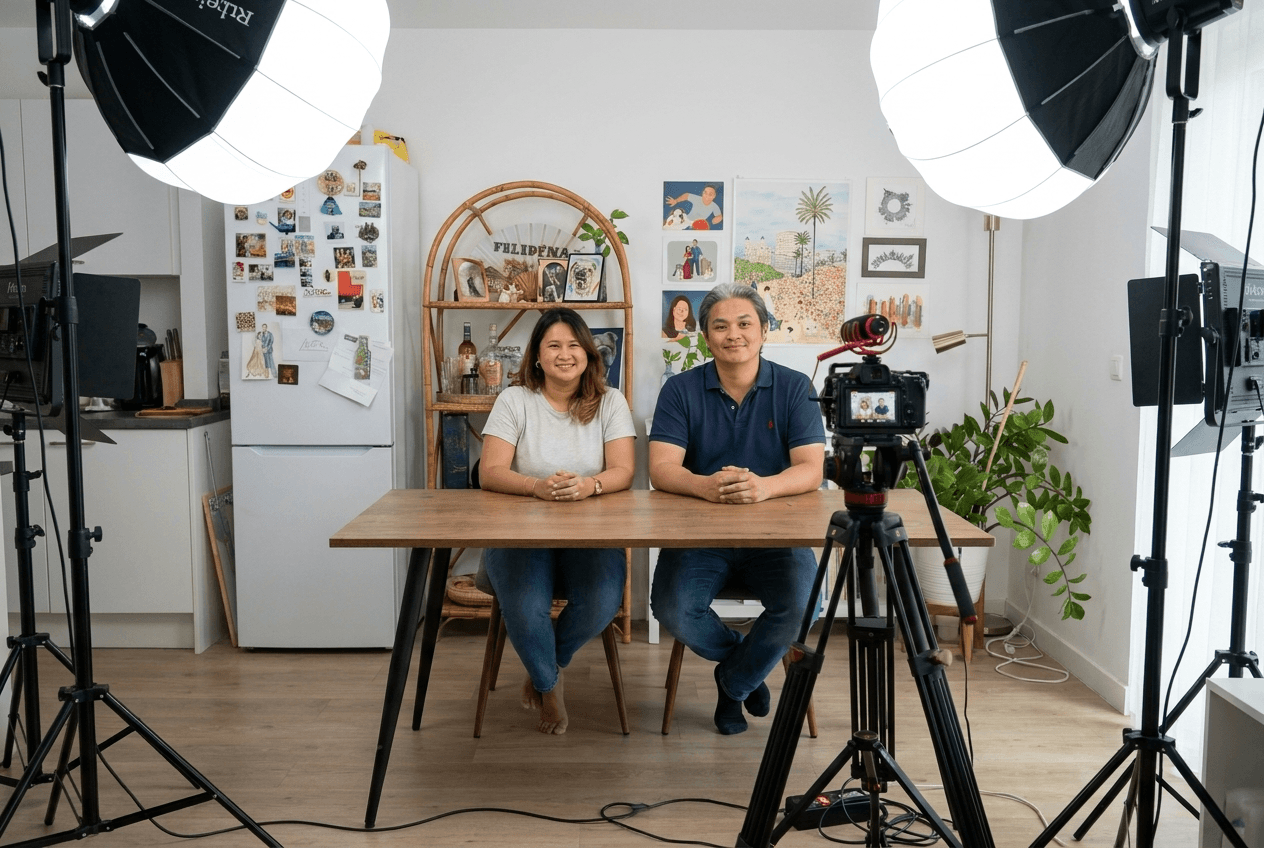
What's on this page comes from Marina Henestrosa at Bureaucracy.es, the immigration team we've worked with longest, sharing this at our Spain Sessions event in Manila, plus the video linked above where we sat down with her to go through it directly.
THE PART THAT MAKES THIS DIFFERENT IF YOU'RE FILIPINO
Why This Path Looks Different for Filipinos

This is the part of the DNV that matters most if you're reading this from Manila, Dubai, Singapore, or anywhere else in the diaspora.
Most nationalities need ten years of legal residency in Spain before they can apply for citizenship. Filipinos need two. Article 22 of Spain's Civil Code sets a two-year residency requirement for citizens of the Philippines, along with a small group of countries with historic ties to Spain, instead of the standard ten. The DNV is renewable and counts toward that residency clock the same as other Spanish visas do.
There's a second detail that matters as much as the shorter wait. Spain typically requires new citizens to give up their original nationality. The Philippines is exempted from that under Article 24, so becoming Spanish doesn't mean giving up your Philippine passport on paper. Republic Act 9225 also lets Filipinos who've naturalized abroad reacquire Philippine citizenship, so this works in both directions.
We didn't come to Spain on the DNV ourselves, we used the NLV, but the same two-year citizenship framework applies regardless of which residency visa gets you there. We put together two videos that go through the Filipino citizenship angle in more depth:
→ How to Get Spanish Citizenship as a Filipino (Step-by-Step Process) [Watch: Video 1]
→ We Finally Got Our Spanish Citizenship — Here's What's Next [Watch: Video 2]
Citizenship law and the paperwork around dual nationality shift, and the fine print matters more than the headline numbers. Confirm your specific situation with [Bureaucracy.es] before treating any of this as guaranteed.
WHAT THE DNV ACTUALLY IS
What Is the Digital Nomad Visa?
The Digital Nomad Visa (DNV) lets you live in Spain while working for an employer or clients located outside the country. Spain launched it to attract remote workers, freelancers, and business owners whose income isn't tied to a Spanish employer.
Who it fits:
Remote employees working for a company based in the US, the Philippines, or anywhere outside Spain
Freelancers and contractors with foreign clients
Business owners whose company runs independently of their physical location
Who it doesn't fit:
Anyone whose income would come from a Spanish company or from working locally in Spain
Anyone without stable, documented income over the last few months
If your income depends on staying employed and working, and not on savings or a pension, this is likely the right visa category to look at first, rather than the Non-Lucrative Visa.

THE BASICS
What You'll Need to Qualify
Figures below reflect what's applied as of our last update. Spain adjusts the income threshold on a set schedule tied to the minimum wage, so treat the numbers as a starting point and confirm the current figure before you apply. We track updates on the blog.
Requirement cards:
100% Remote Work You need to work fully remotely, either as an employee, a contractor, or a business owner, for a company based outside Spain. Working for a Spanish company disqualifies the application.
Stable Income The threshold is set as a multiple of Spain's minimum wage and increases each year. Solo applicants currently need to show monthly income around €2,800, with roughly €1,100 more per dependent family member. What matters most is the average over your last three months of income, not a single strong month.
Clean Criminal Record Covering the last two years of residence. If you've lived in more than one country during that window, plan for a record from each one.
Company History Proof that the company you work for (or your own business) has been active for a set period, along with documentation of your working relationship.
The income averaging rule matters more than people expect. If your income swings month to month since you freelance, the last three months as a group are what gets reviewed, not your best month.

A few things from our conversation with Marina at Bureaucracy.es stood out, and they're worth knowing before you start gathering documents:
Rejections on the DNV are less common than on other visas, since the requirements are more straightforward to prove with pay stubs, contracts, and bank statements. Getting the financial documentation right the first time is still where most delays happen.
If your spouse comes with you, they get the right to work in Spain too, either as an employee or by starting their own business. That's not automatic on every visa category.
If you apply from inside Spain rather than through a consulate abroad, processing has been running around 20 business days, and the visa is valid for three years.
We go deeper into all of this in the video below, recorded with Marina on the Digital Nomad Visa:
TIMELINE
How Long Does This Actually Take?
Document prep: Employment or client contracts, three months of income records, company registration documents, criminal background checks, and apostilles.
Choose where you apply: From a Spanish consulate abroad, or in person after entering Spain on a different status. Each route has its own timeline.
Processing: Applications filed within Spain have been moving faster than consulate applications abroad. Confirm current wait times before you plan a move date around either option.
Approval and setup: Once approved, you'll register your residency (TIE card, empadronamiento) and get set up locally.
Note: Processing speed and rules shift. We keep the blog updated with what applicants are actually experiencing.
WHAT HAPPENS AFTER YOU LAND
Getting Approved Is the Start

Nobody warns you that the visa is the easy part compared to actually settling in. A few things worth thinking about now, before you land:
You'll still need private health insurance. Full coverage, no co-payments, same standard as other Spanish visas. We use InnoInsure ourselves and send our audience there since their policies are built around exactly what Spanish consulates expect from a foreigner.
→ [Compare visa health insurance options]
Your spouse's right to work opens up real options. If your partner wants to work locally, start a business, or freelance in Spain while you keep your foreign income, that's built into this visa category. Worth planning around before you land, not after.
If you're buying rather than renting. Foreign mortgages work differently, and we recorded a conversation with Mirelle at The Spanish Nest on exactly this.
→ [Watch our mortgage conversation]
If coordinating all of this from abroad feels like a lot. Our relocation service in Valencia, run with Dave and Jesús, handles the local setup, from housing to registration, so you're not doing it solo in a language you don't speak yet.
MINI COURSES
Already Deciding Where to Land?
We're Ready to Help!
A lot of people get the visa question answered and realize the harder question is where in Spain to actually live. We put together three guides based on what we wish we'd had before we moved:
Spain City Guide — breakdowns of 50 cities across four categories, from the most popular expat hubs to the ones almost nobody talks about yet
Apartment Hunting Guide — how to actually find and secure a place as a foreigner
Timeline and Checklist — the order of operations so you're not scrambling
FAQS
Still Have Questions?
The Digital Nomad Visa Questions We Get Asked the Most
We get Digital Nomad Visa questions constantly, more than almost any other topic. We put the recurring ones in one place, answered directly.
These are the real questions we see over and over in comments and DMs about Spain's Digital Nomad Visa, answered directly.
Both. You can qualify as an employee working remotely for a foreign company, a contractor, or the owner of a business that runs independently of your location in Spain.
Not on its own. What gets reviewed is the average of your last three months of income against the required threshold, not a single high or low month. Freelancers with irregular income still qualify if the average holds up.
It's tied to Spain's minimum wage and adjusts on a yearly schedule, so the exact figure moves. We keep the current number on the blog rather than freezing it here.
Yes. This is one of the advantages of this visa category specifically: your spouse gets the right to work locally, as an employee or by starting a business, while you continue earning from outside Spain.
If they're minors living with you, they'll need to study in Spain, in a public, private, or hybrid school. It's part of residing in the country with your family.
The NLV requires you to stop working and support yourself through savings, a pension, or passive income. The DNV lets you keep working, as long as the income is remote and comes from outside Spain. If you have a job or clients you can keep, the DNV is almost always the better fit.
Once you've spent more than 183 days in Spain in a year, you become a tax resident there. The specifics of what that means for your foreign income are worth a conversation with a tax professional, not something to guess at from a blog post.
It depends on where you apply. Applications filed in person after entering Spain have been moving faster than ones filed through a consulate abroad. Confirm current timelines with [Bureaucracy.es] before locking in a move date.
Current terms run around three years, renewable if you still meet the requirements.
Time spent on the DNV counts toward the residency period required for citizenship, the same general framework as other Spanish residency visas. We didn't personally go through this path ourselves, so for anything specific to your situation, talk to [Bureaucracy.es] directly.
On the blog, where we update it as the numbers change: [DNV Blog Updates]
Yes. Our relocation service exists for exactly this. [See what that support looks like.]
MINI COURSES
The Next Step Is Simple
Follow the blog for real DNV updates as the income threshold and rules shift year to year.
Get the Latest DNV Updates
→ (Click HERE)
Talk to the team that files these applications for people like you
→ (Bureaucracy.es)
Whatever you choose next, this is one of the few visas out there that doesn't ask you to prove your worth to an employer. It just asks you to show you're ready. We think that's worth pursuing.

Helping everyone move to Spain — with courses, consultation, and real first-hand experience from Valencia.



Join our newsletter
© 2026 Everything is Boffo. All rights reserved.
*Some links may be affiliate links. Using them helps support us at no extra cost to you.
Access the Digital Nomad Visa Spain Guide for Filipinos
Enter your email below to access this free guide. If you're new here, you'll also receive our FREE Spain Starter Kit!
No spam. Just practical guidance to help you move forward.