
Spanish Healthcare for Foreigners
What Health Insurance Do You Actually Need to Move to Spain?
We get asked this almost every week. So here's everything we know, from our own visa application to an eight-day hospital stay, in one place.
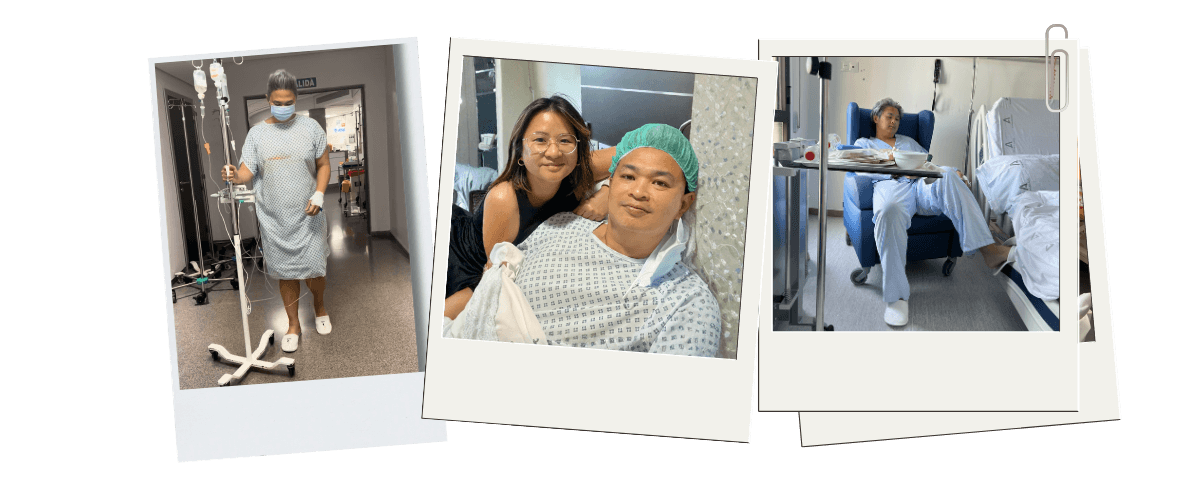
Hola, it's Paul and Bea.
If you clicked through to this page, you're probably staring down one of the most confusing parts of moving to Spain: the private health insurance requirement. We were there too. We didn't know what "no co-payments" meant, we didn't know if our prescriptions would carry over, and we definitely didn't know what would happen if one of us actually got sick.
Two years and one gallbladder surgery later, we know a lot more. This page covers what the insurance requirement actually is, what it costs, what happens with pre-existing conditions, and how the public system fits in once you've been here a while. We also link out to our insurance partner, InnoInsure, where we'd point our own family.
OUR STORY
We're not insurance agents. We're just the people who had to figure this out.
We moved to Valencia from Southern California with six suitcases, our dog, and zero experience with European healthcare. One of the actual reasons we left the US was healthcare. We lost a family member to cancer, then COVID hit four months later, and we got a hard look at how thin our US coverage really was.
In our first year and a half in Spain, between the two of us, we used our insurance for annual checkups, an ER visit, a women's wellness exam, random ultrasounds, an MRI, an endoscopy, an EKG, and an eight-day hospital stay with laparoscopic gallbladder surgery. We walked out of the hospital without signing a single form or paying a single euro at the door. Five months later, we still hadn't received a bill, and we never will.
That experience is the reason we keep talking about this topic. Not because an insurance company asked us to, but because the difference between "covered" and "not covered" in a foreign country is the kind of thing that changes how you sleep at night.
WATCH OUR FULL EXPERIENCE
This is the one where we tell you exactly what our insurance cost us, what the hospital stay was actually like, and the mistake we made trying to "help" by calling the insurance company ourselves before the surgery (don't do what we did).
WHAT THE VISA ACTUALLY REQUIRES
What Spain's health insurance requirement actually says
If you're applying for a Non-Lucrative Visa, a Digital Nomad Visa, a Student Visa, or your NIE/TIE residence card (including renewals), Spain requires private health insurance that meets specific conditions. This comes from Spain's Foreigners Law (Ley Orgánica 4/2000) and its implementing regulation (Royal Decree 557/2011), plus Law 14/2013.
Your policy has to:
Be issued by a company authorized to operate in Spain
Give full coverage: emergencies, consultations, diagnostic tests, surgeries (inpatient and outpatient), and hospitalization
Carry no coverage limit
Have no co-payments
Have no deductibles
Have no waiting period
Include repatriation of remains
Cover your entire planned stay in Spain
A few consulates add their own extra conditions. The San Francisco consulate, for example, requires that pre-existing conditions not be excluded from the policy. Always check your specific consulate's checklist, because requirements can vary by location even within the same visa type.
One thing worth a quick note for anyone who's seen "Golden Visa" mentioned in older insurance guides (including some of our own older videos): Spain closed the real estate investment route to new Golden Visa applicants in April 2025. If you already hold one, you can still renew it. If you're just starting your research, the realistic paths into Spain right now are the Non-Lucrative Visa, the Digital Nomad Visa, the Student Visa, and family reunification.
PRIVATE INSURANCE VS. THE PUBLIC SYSTEM
Private insurance now, public healthcare later
Here's the part that confuses almost everyone, including us at the start.
When you first arrive on a visa, you're required to carry private insurance. That's not optional, and it's not the same as the free travel insurance you might already have through a credit card (travel insurance caps out around 90 days and doesn't meet visa requirements at all).
After you've been registered as a resident (on the padrón) for 12 continuous months, you become eligible to pay into Spain's public healthcare system directly through something called the Convenio Especial. As of 2026, that costs:
€60 per month if you're under 65
€157 per month if you're 65 or older
It's a flat fee, not based on income. It gets you full access to the public system: GPs, specialists, hospitals, and emergency care. What it doesn't cover is the full cost of prescriptions (you pay a percentage out of pocket) and most dental work.
We've personally stuck with private insurance even after becoming eligible for the Convenio Especial, mostly because we like being able to pick our own specialists without a referral and skip the longer public waitlists. Plenty of long-term residents run both at once, or switch to public once they're settled. Neither choice is wrong. It depends on what you want from day-to-day healthcare versus what the visa requires you to have on paper.
The full breakdown, with an actual insurance agent
We sat down with Ciaran from InnoInsure to go through the requirements line by line: what counts as "full coverage," how dental and vision actually work, what prescriptions cost compared to the US, and real price examples by age group.
PRE-EXISTING CONDITIONS
"But I have a pre-existing condition. Can I even get covered?"
This is the question we get the most, by far, and it deserves a straight answer: it's case by case, but pre-existing conditions are not automatically excluded.
Here's how it works in practice. You submit details about the condition, and a medical review team evaluates it. If it's approved (which InnoInsure tells us happens in the large majority of cases), your consultations and checkups related to that condition are covered from day one. Surgeries and high-tech examinations related to it usually need separate authorization first. Your premium may go up depending on the severity of the condition, but the condition itself isn't excluded from the policy.
Conditions like high blood pressure, diabetes, high cholesterol, and old injuries are common examples that get approved regularly. What's not covered under most policies, pre-existing or not, is the cost of ongoing prescription medication itself (though some insurers cover up to 50% of that cost, capped annually).
If you're moving to Spain specifically because of a health situation that didn't get the care or affordability you needed elsewhere, this is the conversation worth having directly with an agent before you assume you don't qualify.
Pre-existing conditions, in detail
We asked Ciaran the question everyone in the Facebook groups asks but nobody answers directly: what actually happens to your application if you have a pre-existing condition. This is the most specific and most requested video we've made on this topic.
FAQS
Q: Does the insurance cover dental? Simple extractions and an annual cleaning are typically included. Fillings and other procedures are usually a separate add-on or paid out of pocket. Dental coverage varies by insurer, so confirm what's included before you buy.
Q: Does it cover vision? Visiting an eye doctor for an issue or treatment is covered. Glasses and contact lenses are not.
Q: Are prescriptions covered? Generally no, you pay for medication out of pocket at the pharmacy. The upside: prescription costs in Spain are typically far lower than in the US. We've personally paid around €4 for a 30-day prescription that cost us a $15 copay on top of insurance back in the US.
Q: Is mental healthcare covered? Yes. Psychiatry and psychology sessions are generally included, usually starting with a psychiatrist referral.
Q: Can I find English-speaking doctors? Yes, most insurers let you filter their provider directory by language. Bigger hospitals tend to have more English-speaking specialists than smaller local clinics.
Q: How fast do I get my insurance documents for my visa appointment? Typically within 1 to 3 working days after you complete your purchase.
Q: Do I need a Spanish bank account to buy a policy? No. You can purchase with any debit or credit card from any country.
Q: Is COVID-19 still covered? Yes, testing and treatment are included.
Q: What if my visa or NIE application gets rejected after I've already paid for insurance? Most insurers will refund the unused months if you provide your policy certificate and the official rejection letter.
WHY WE PARTNER WITH INNOINSURE
Why we send people to InnoInsure specifically
We don't take every insurance partnership that comes our way. We picked InnoInsure because their policies are built specifically around what Spanish visas require, their support team works in English, and we've personally watched the process work end to end with our own viewers.
A few things worth knowing about them:
They're the licensed international office for two of Spain's largest insurers, DKV and Asisa, not a third-party broker
Their network covers over 43,000 doctors and 1,200 medical centers nationwide, including the Canary and Balearic Islands
No advance payment at the hospital. You show your card, they bill the insurer directly
Worldwide emergency travel coverage is included if you travel outside Spain (except your home country)
Customer support in English, plus several other languages
According to InnoInsure, they've supported more than 100,000 international students and immigrants and no applicant has been rejected from a visa or NIE process specifically because of their insurance
READY TO GET A QUOTE?
You can get an instant quote in a few minutes, with no Spanish bank account required and documents sent within 1 to 3 working days.
We work with InnoInsure as a referral partner, which means we may earn a small commission if you sign up through this link, at no extra cost to you. We only recommend insurers we'd use ourselves, and we did.
Have a specific question about your situation? InnoInsure's team can walk you through it directly, agent to applicant, before you commit to anything.
Disclaimer:
This page contains a referral link to InoInsure. If you contract them through our link, we may receive a commission at no additional cost to you.
Visa approval is always at the discretion of the relevant consulate and is not guaranteed by InnoInsure or by Everything is Boffo. This content is for informational purposes only and does not constitute immigration, legal, medical, or financial advice. Always consult the appropriate professionals and verify current requirements with your consulate before making any medical or relocation decisions.
Everything is Boffo is not affiliated with DKV or Asisa.

Helping everyone move to Spain — with courses, consultation, and real first-hand experience from Valencia.



Join our newsletter
© 2026 Everything is Boffo. All rights reserved.
*Some links may be affiliate links. Using them helps support us at no extra cost to you.
Access the Spain Health Insurance Guide
Enter your email below to access this free guide. If you're new here, you'll also receive our FREE Spain Starter Kit!
No spam. Just practical guidance to help you move forward.