Moving to Spain With a Disabled Child: One Family's Story
What Happened When a Family With a Son Who Has a Learning Disability Moved From the US to Spain 🇪🇸
A conversation with our friends and neighbors — and an honest look at what Spain's system offers that America's stops providing at 18.
We want to be clear about something before we start.
We don't have kids. We have no personal experience navigating what it means to raise a child with a disability — the 247 reality of it, the planning, the worry, the way every single decision your family makes runs through one central question: what does this mean for him?
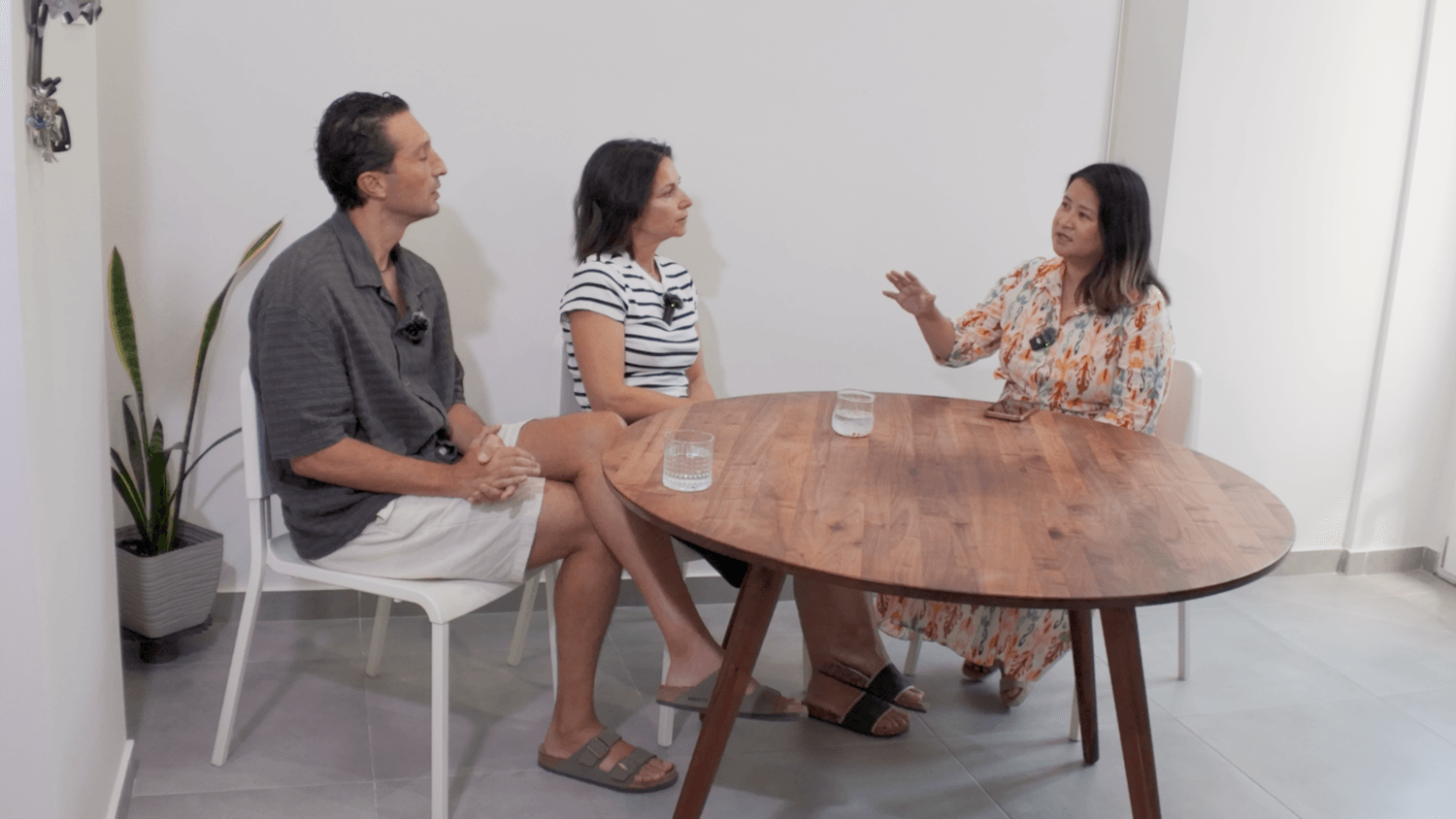
So when our friends and neighbors Fabio and Annelise — who have been living here in Valencia for four years — agreed to sit down with us and talk openly about why they moved from the United States to Spain specifically because of their son Julian, we knew this was a conversation our audience needed to hear.
Julian is 23. He has a learning disability. And his story — and his family's story — tells you something about Spain that no cost of living breakdown or visa guide can.
The family: 25 years in America, a decision made during COVID.
Fabio is Costa Rican. Annelise is French. They met in the US, raised their children in Michigan, Dallas, Arkansas, and Baltimore, and spent 25 years building their adult lives there. They have two children: a daughter who was finishing high school when they moved, and Julian, who had just graduated from a specialized school for students with learning disabilities in Baltimore called Lab School.
Julian graduating was a milestone. It was also, as Fabio described it, a terrifying cliff edge.
"In the US, there's a lot of support and the system is very well done for a child who has a disability from kindergarten until they exit — until 18 or 21," Annelise explained. "But after that, all that support kind of disappears. And your personal situation is just like everybody else's — but if you have a disability, you do need that support."
So what happens to a young adult with a learning disability in America when the school system stops holding the door open?
"If you're going to look for a job, well, you compete with everybody else. And it's a competitive market. If you want to have an independent life, you have to drive in the US. But what if you cannot drive? Then that's a problem — for them and for you."
Fabio paused when we asked whether discrimination plays a role. "I'm not going to say discrimination, although that happens too. But you face misunderstanding. People who don't see your disability and don't adapt the workplace or their life around that disability."
The COVID conversations that changed everything.
Like so many families, COVID gave them time they had not had before. Time to ask the questions they had been too busy to sit with: what does the next five years look like? The next ten? What happens to Julian when they are no longer able to manage everything for him?
"Having a child with a disability is not about them only," Fabio said quietly. "Families are impacted right away. Your marriage will be impacted. Your other children will be impacted. And that pressure, that stress, that responsibility that you have wears on you heavily."
They decided to leave the US. They considered France. They considered Ireland. But they kept coming back to Spain. The cost of living was lower. The weather was better. Valencia had an American-curriculum school for their daughter who still had two years of high school to finish. And Fabio, having grown up in France, had an instinct that Europe handled disability differently.
"I knew of those associations — for people with disability that give you either activities, support, or they get together. I kind of had an idea of what it was."
What Spain actually offers — the legal framework first.
Before getting into Fabio and Annelise's specific experience, it helps to understand what Spain has actually built for people with disabilities — because the scale of it is genuinely significant and most people researching a move here never find it until they need it.
Spain ratified the United Nations Convention on the Rights of Persons with Disabilities on December 3, 2007, committing to international standards on disability rights, including the promotion of community-based living over institutionalization.
The Real Decreto Legislativo 1/2013, approved on November 29, 2013, consolidated the General Law on the Rights of Persons with Disabilities and Their Social Inclusion, reinforcing the social model of disability by mandating accessibility, non-discrimination, and support for personal autonomy.
In 2025, Spain went further still — twice.
Law 2/2025, published on April 30, 2025 and effective from May 1, 2025, marks a significant shift in the rights of workers with disabilities. The law eliminates the automatic termination of contracts due to severe or permanent disability, instead requiring employers to assess and implement reasonable workplace adjustments before any termination can be considered. Contracts can only be ended if adjustments impose a significant burden, no compatible positions exist, or the worker themselves rejects a new position.
Then in July 2025: the Council of Ministers sent to Parliament the joint reform of the laws on the rights of persons with disabilities and the promotion of personal autonomy and care for dependent people. The Minister for Social Rights described it as "possibly the most important social reform of this legislature," with the goal of laying the foundations of a public and universal system that enshrines the right of citizens to wellbeing, to be cared for, to equality, and to live a full life in conditions of freedom and autonomy.
Funding for dependency services reached a record €3.7 billion in 2025, with reforms designed to expedite evaluations and reduce waiting lists. Key updates include eliminating incompatibilities between dependency benefits and employment income, enabling beneficiaries to combine work with aid, and prioritizing vulnerable subgroups such as children, rural dwellers, and those with severe needs.
The certificado de discapacidad — the first and most important step.
One of the most striking moments in our conversation came when Annelise talked about trying to research Spain's disability support system from the United States.
"It's so funny when she says search words," Fabio said. "You don't know what to search for. You don't know what to Google for."
The first thing they had to learn: in Spain, disability is a legal category with a specific term — discapacidad — and a formal certificate called the certificado de discapacidad. Without that certificate, you do not officially have a disability under Spanish law and cannot access the benefits attached to it.
A disability assessed and recognised abroad is not valid in Spain — there is currently no EU legislation that regulates and authorises the mutual recognition of disability status between member states. You must go through Spain's own assessment process regardless of your home country's documentation.
Together with the assessment decision, you are issued a Tarjeta acreditativa de persona con discapacidad — a disability card valid throughout Spanish territory — if your degree of disability is recognised at 33% or more. The card indicates the degree of disability, the period of validity, and if applicable, mobility difficulties and the need for a third person. If no improvement is foreseeable, the recognition is granted permanently with no expiry date.
Once the certificate is in hand, the picture changes substantially. Fabio explained the structure clearly: "If any private workplace has 50 or above employees, they have to by law reserve 2% of their job placements for people with disabilities. 10% of public job offers have to go to people with disabilities."
The employer incentives behind this quota are significant. Employers who hire a disabled worker on a permanent contract are entitled to a grant of up to €901 to adapt their premises, a deduction of €6,000 on Corporate Income Tax, and a wage subsidy of up to €3,907 per employee. They also receive bonus reductions on social security contributions ranging from €4,500 to €5,700 per year depending on the employee's disability level, age, and gender. Spain is, in other words, actively incentivizing employers to hire people with disabilities — not just legally requiring it.
And the financial protections for the person themselves compound from there.
Julian pays reduced taxes on his income. Reduced taxes on transportation. Reduced purchase tax on a home. At the cinema, he pays less. On public transport in Valencia, he travels free. "For someone with reduced hours, earning less — it helps that he doesn't have to pay as much to enjoy himself, to do something that a person with a normal salary just goes and does," Fabio said.
The associations — what they found that changed everything.
When they arrived in Valencia, Fabio and Annelise did something methodical: they researched associations, contacted ten of them, met with each one, and explained Julian's situation. Five said it was not a good fit. Five said yes.
They ended up finding what Annelise described simply as the answer.
Spain's disability associations — many operating under the broader legal framework requiring workplaces and public entities to accommodate people with disabilities — are community-run organizations that do something the American system largely does not: they pick up where school leaves off and keep going.
"The association was the answer," Annelise said. "He's starting to make friends. Last weekend he went to the beach with a friend. For me, as a mom, if my child tells me 'Oh mom, I'm going to the movies with friends' — I'm happy. Go."
These associations run talleres — workshops — on practical life skills: how to manage money, how to do laundry, how to cook, how to handle an electricity bill, how to make the transition toward independent living. They connect families with specialized psychologists. They run leisure activities — including, as Fabio described with evident delight, a weekly chess workshop run by professional chess players who volunteer their time every week.
"You learn Spanish while you play chess. So, it's not that I was thinking intellectually. This is what actually happens."
The association Julian is now part of serves young adults between 18 and 30. It currently has 42 families. Fabio is now on the board of directors.
"If you don't have enough money, the association helps you with that," he explained. "It is a tool. So if your child needs psychological services — specialized ones — where do you find them? The association would know."
It also gives parents something Fabio and Annelise had not found in the United States: community knowledge. The collective memory of families who have already navigated the specific challenges you are just now approaching.
"Every year there's a new surprise. Every year there's a new challenge. It's never ending. The association in that sense brings that knowledge, brings that experience — and the support that they offer is also something that would be too expensive to pay for yourself."
Annelise remembered something they had not expected: the loneliness of raising a child with a disability in the US without a community around them.
"When we lived in Arkansas, Julian was in his class by himself. He's a child who's having emotions and it's hard to make friends and the communication was really an issue. If we had had this association like the one we found here — I think his life would have been very different. And ours too."
The disability strategy — where Spain is heading.
What Fabio and Annelise found when they arrived in Valencia is not accidental. It reflects a deliberate national policy direction.
The Spanish Disability Strategy 2022 to 2030, approved by the Council of Ministers on May 3, 2022, drives targeted amendments to enhance legal capacity and promote inclusive models, replacing segregated services with community-based support in line with UN Convention obligations.
The strategy covers eight areas: equal recognition before the law, accessibility, independent living, education, employment, health, social protection, and participation in political and public life. Each area has specific targets, timelines, and monitoring mechanisms.
The direction of travel is clear: away from institutionalization, toward supported independent living. Away from medical models that classify disability as a problem to be fixed, toward social models that classify inaccessible environments as the problem. Away from charity, toward rights.
Julian's life in Valencia — his job, his friends, his growing independence, his walks to the cinema — is what that policy direction looks like in the daily life of one young man. It is not perfect. It took four years of work, ten association meetings, patience, and language learning. But it is real.

The workplace protections — what changed in 2025.
For families planning a move with an adult child who has a disability and hopes to work, the most significant recent development is Law 2/2025.
Before this law, a worker in Spain could have their employment contract automatically terminated if they were declared to have a severe, absolute, or total permanent disability. Law 2/2025 eliminates that automatic termination. Employers are now required to first assess what reasonable adjustments could allow the worker to continue. The contract can only be ended if those adjustments would impose a significant burden, no compatible position exists, or the worker themselves declines a new role. The law also recognizes the right to suspend employment with job reservation for up to two years following a disability declaration.
Fabio reflected on what this means in practice from personal observation of Julian's situation: "It is very hard to tell a company in the US, please adapt the workplace to his needs. Maybe it is not impossible, but it is certainly easier in Spain to do that."
The moment they knew they had made the right decision.
We asked Fabio directly: if they had stayed in the United States, do they think Julian would be in the same place he is now?
"Has he made more progress than I think he would have done otherwise? My answer is yes. Why? Because I see him. He's relaxed. He's happier. He has access to resources he didn't have before."
He paused. "You're more protected as a person with a disability here. You're way more protected. You're not so exposed to the wings of the marketplace or the job market."
Annelise's answer was quieter but perhaps more revealing.
"Since we've been here, I have a better vision of what his life is going to look like. And I'm not as worried. I'm convinced that his quality of life is going to be better here than in the US. So, I'm more at peace."
Julian — in his own words.
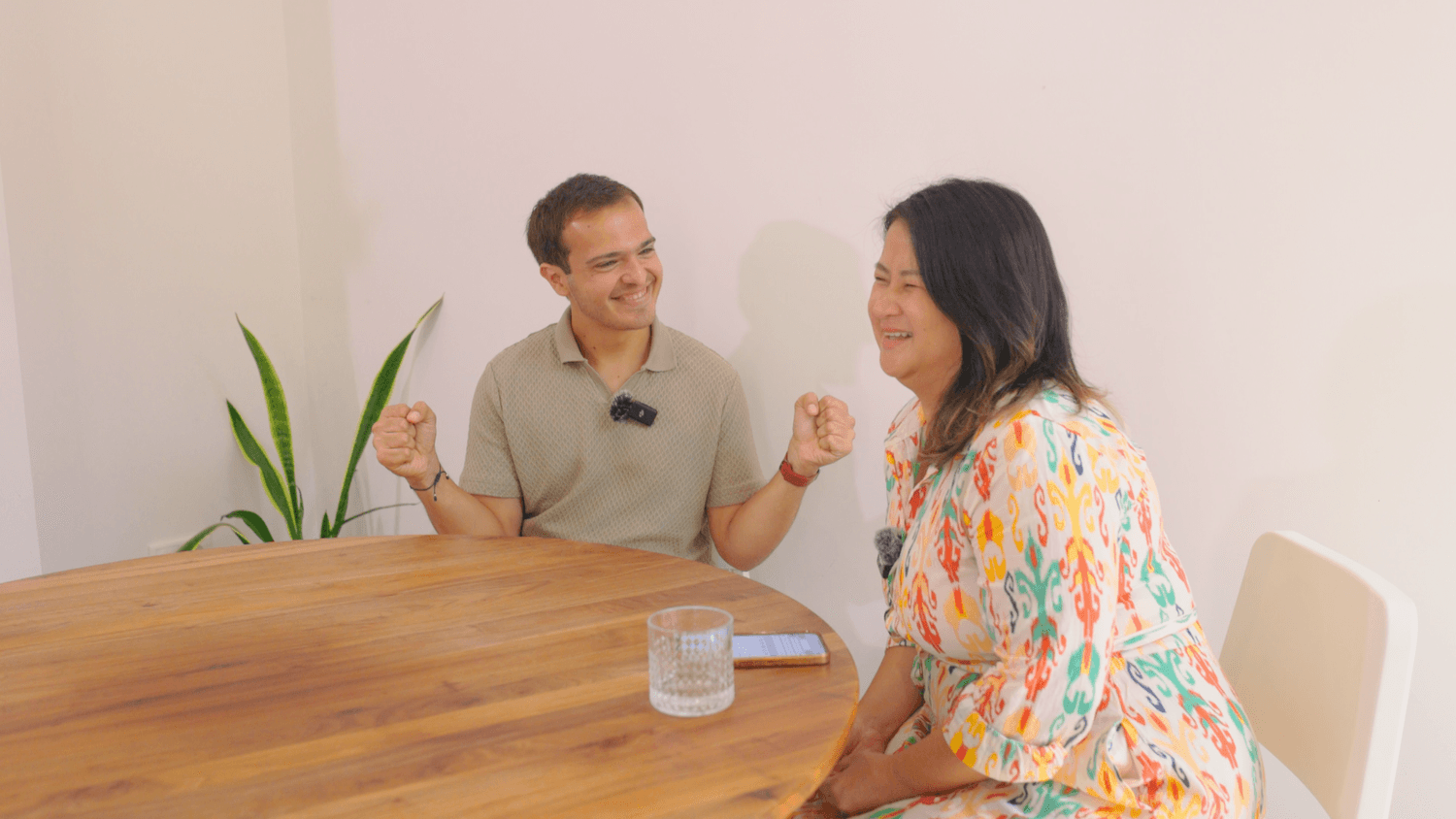
At the end of our conversation, Julian himself joined us. He is 23, has been living in Valencia for four years, has a job at a clothing store, goes running every morning, studies Spanish, has friends he goes to the movies with, and when his parents travel has stayed alone in the apartment for weeks at a time.
We asked him how he felt when his parents said the family was moving to Europe.
"At the moment, it was surprising. I said, 'Really? Okay, I'm cool with it.'"
We asked him how he found his friends.
"With my parents' help a lot. It was hard. Many tries. But at least we found some that say — this is good for me."
We asked him what his favorite part of his day is now.
"Going on a run. Just helps me relax."
And we reminded him of what he had told us years earlier, when we had asked him whether he was happy here.
"The truth is, I'm happy everywhere."
He smiled. His parents laughed. And we sat with that for a moment.

What this means for families considering Spain.
If you are researching a move to Spain with a family member who has a disability — physical, learning, developmental, or otherwise — here is what this conversation and the data behind it taught us.
The support system does not disappear at 18 the way it does in the US. Spain's associations, its legal employment quotas, its disability certificate system, and its community-based infrastructure exist specifically to support adults with disabilities through the entire arc of their lives.
The legal employment protections are real, specific, and recently strengthened. The 2% private sector quota, the 10% public sector quota, and the employer incentives that make hiring people with disabilities financially attractive to companies — these are not aspirational goals. They are enforced law.
The Spanish government's stated goal is to lay the foundations of a public and universal system that enshrines the right of citizens to wellbeing, to be cared for, to equality, and to live a full life in conditions of freedom and autonomy. That language is worth taking seriously — not because governments always follow through on stated goals, but because Spain has been consistently building in this direction for over a decade, with record funding in 2025 and new legislation in both April and July of that year.
The walkable, compact European city model matters enormously for people who cannot drive. In Valencia, Julian walks to work, to the cinema, and to meet his friends. The city was designed for people on foot. That design choice is transformative for someone whose independence does not include a car.
Getting the certificado de discapacidad is the first and most important administrative step after arriving — and it must be done through Spain's own process, not transferred from your home country.
Spanish is not optional. The associations operate primarily in Spanish. The workshops, the relationships, the community all require real engagement with the language. Coming with a plan to learn Spanish is not a suggestion. It is the condition on which everything else depends.
You need a plan. "I don't think you can come without a 100% control plan," Fabio said. "It doesn't have to be a perfect plan. It will not be a perfect plan. But you have to have an idea that is realistic about what you will face."
The full conversation — including Julian speaking for himself, the details of how the associations work, and Fabio and Annelise's advice to families who are exactly where they were four years ago — is in the video.
It is one of the most honest conversations we have had on this channel. We think it will matter to a lot of people.
👉 Watch the full video here:
❤️ SUPPORT THE ASSOCIATION HERE
As a gesture of appreciation for supporters contributing €100 or more, they may have the availability to personally do a “thank you” call. (This is optional, based on availability, and not connected to the donation itself.)
🇪🇸 Planning your move to Spain and not sure where to start? We’ve put together the exact network of professionals we trust ourselves, from immigration lawyers and visa experts to health insurance providers, tax specialists, relocation support, and more. These are the people helping our community make the move without losing their minds in Spanish bureaucracy.
👉 Explore our trusted Spain experts here: Partners
☀️ We don’t think you should have to spend thousands trying to figure out how to move to Spain or piece together advice from scattered sources online. That’s exactly why we created our mini courses. They are designed to give you the specific, practical information we wish we had before moving, from visas and paperwork to cost of living, housing, and what daily life actually feels like once you arrive.
👉 Access the mini courses here: Mini-Courses
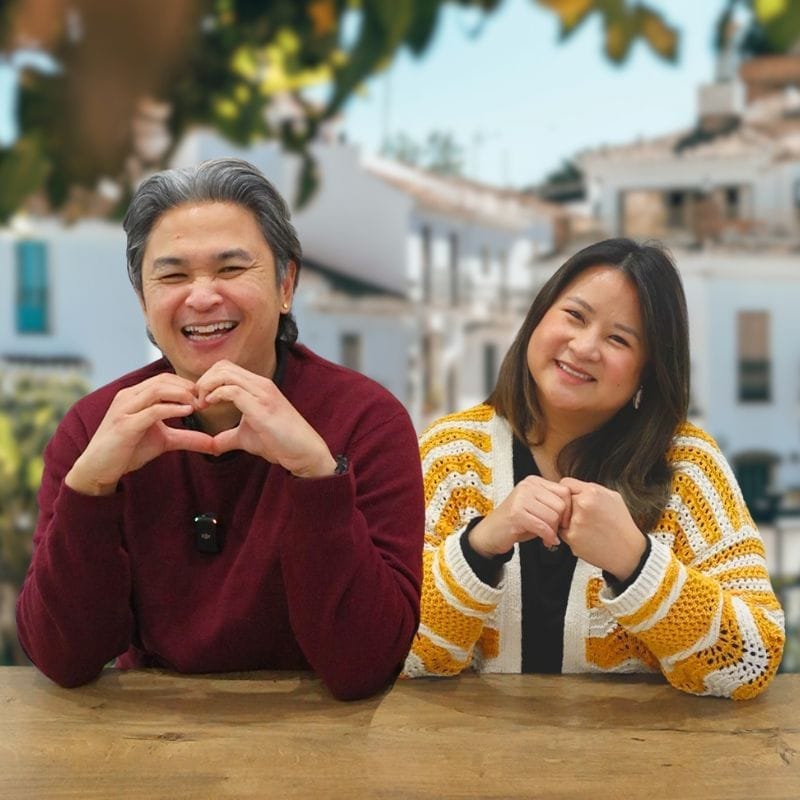
Hello, we're Bea and Paul…
...and we know exactly what it’s like to chase that better life. We spent 13 years working hard in Southern California, but after wrestling with one immigration hurdle after another, we realized that the "American Dream" wasn't quite working out for us. So, we sold everything, packed our bags, and moved to Spain—site unseen!
Our YouTube channel, Everything is Boffo (Life in Spain), tells the whole crazy story, from our first jamón to navigating our own residency here. We share the realities of life in Spain, the slow travel, the good food, and how we make it all happen.



Disclaimer: This content is provided for general informational and educational purposes only and should not be considered legal, financial, tax, medical, or immigration advice. Rules, visa requirements, housing regulations, tax obligations, and public services in Spain can change frequently and may vary depending on your nationality and personal circumstances. Always verify information with official government sources or qualified professionals before making decisions. Some links, resources, courses, consultations, and recommended services mentioned throughout our content may be affiliate partnerships, meaning we may earn a commission at no additional cost to you if you choose to use them. We only share resources, professionals, and services we genuinely trust or believe may be useful to our community. Any opinions expressed are our own and based on personal experience, research, interviews, and publicly available information at the time of publication.
Support from readers who use our links, courses, or resources helps us keep this information free, maintain the platform, and quite literally keep the lights on at home so we can continue producing guides like this for the community.
Newsletter
Subscribe now to get the latest updates.
Created with © systeme.io