How to Move to Spain as an English Teacher (2026 Complete Guide)
Want to Move to Spain?
Teaching English Might Be Your Easiest Path
Your English is your most underestimated asset. Here's how thousands of Americans are using it to move to Spain legally — and stay.
Most people researching how to move to Spain land on the same short list: the Non-Lucrative Visa, the Digital Nomad Visa, maybe the Golden Visa if the budget allows. What almost never comes up — and what might be the most practical pathway for the average person — is teaching English.
Not because it's a secret. Because nobody explains it properly.
We sat down with Tita Ashton, CEO of EBC Trinity CertTESOL, inside our home in Valencia. She flew in from Madrid specifically for this conversation. What followed was one of the most practical, eye-opening discussions we've had on the channel about how to actually get to Spain — and stay — when you don't have a remote job or a six-figure savings account.
Tita has spent more than 20 years in this space. EBC started as a business and corporate English school in Madrid serving the financial sector — banks, consulting firms, financial services companies. Over time, they built their own teacher training division on the Trinity College framework. Today they certify teachers who go on to work in 109 countries across 2,351 partner language schools worldwide.
This is everything she told us. But the full conversation — including the moments that genuinely surprised us — is in the video. Watch it before you start any applications.
Why English Teaching Is One of the Best Pathways Into Spain
Here's the fundamental problem most people face when they want to move to Spain without a remote income: Spain requires you to prove you can support yourself financially before they give you residency. And most visa routes require either a passive income, a foreign employer, or significant savings.
Teaching English sidesteps that problem in a unique way.
If you hold an internationally recognized English teaching certification, language schools in Spain will hire you. They will pay you. And in the case of the Road to Spain pathway we're about to cover, some of them will eventually sponsor your work visa.
The logic Tita laid out was straightforward: when you move to a country where you don't speak the local language, you can't walk into a Spanish company and interview in Spanish. But you can walk into a language school and teach English. That certification becomes your bridge — the skill that earns you income while you learn the country, build connections, and develop the Spanish you need to eventually transition into whatever you really came here to do.
She told us about a graduate who arrived in Spain speaking zero Spanish, taught English for a year and a half, picked up the language fast, and is now an assistant manager in the engineering department of a major Spanish company. That's not the exception. That's the model.
TEFL vs. TESOL: What's the Difference?
Before we get into EBC's specific certification, let's clear up the terminology — because this confused us too when we first started looking into it.
TEFL — Teaching English as a Foreign Language
This is what you do when you teach English in a country where the students have a different first language. In Spain, everyone's first language is Spanish — so if you're teaching English here, you're doing TEFL.
TESOL — Teaching English to Speakers of Other Languages
This is what you do in countries where English is the primary language. If you're teaching an immigrant English class in the United States, or helping non-native speakers in the UK — that's TESOL.
Why this matters: Most English teaching certifications give you one or the other. If you're only TEFL certified, you can't teach in your home country. If you're only TESOL certified, you can't teach abroad where English isn't the first language.
EBC Trinity CertTESOL gives you both. One four-week course, dual certification. You're covered everywhere.
What Is the Trinity CertTESOL — and Why Does It Matter?
There are two English teaching certifications that are accepted and recognized by the British Council worldwide. Two. Not ten. Not fifty. Two.
Trinity CertTESOL is one of them. CELTA is the other.
That distinction matters enormously when you're applying for jobs at language schools abroad. Schools that run professional programs — the kind that hire corporate clients, work with children, or place teachers in universities — require official certification. A Trinity or CELTA certificate tells them you're classroom-ready. A cheaper alternative tells them you're not.
Tita was candid about what she called "cowboy courses" — the $30 online certificates that flood social media ads. She said EBC has seen the same pattern repeat for more than 20 years: someone buys the cheap course, goes to a language school in Spain looking for work, and is turned away because the certificate isn't recognized. Then they come to EBC, do the real course, pay again, and lose months of time in the process.
Her advice: do your research before you enroll anywhere — including EBC. Ask whether the certificate is recognized by the British Council. Ask how many hours the course provides. Ask whether there's actual teaching practice or just theory.
Why the hours matter: British Council recognition requires a minimum of 150 contact hours. Cowboy courses typically offer 120. EBC's Trinity CertTESOL delivers 200. That gap is what separates a certificate that opens doors from one that doesn't.
What You Actually Learn in the Trinity CertTESOL
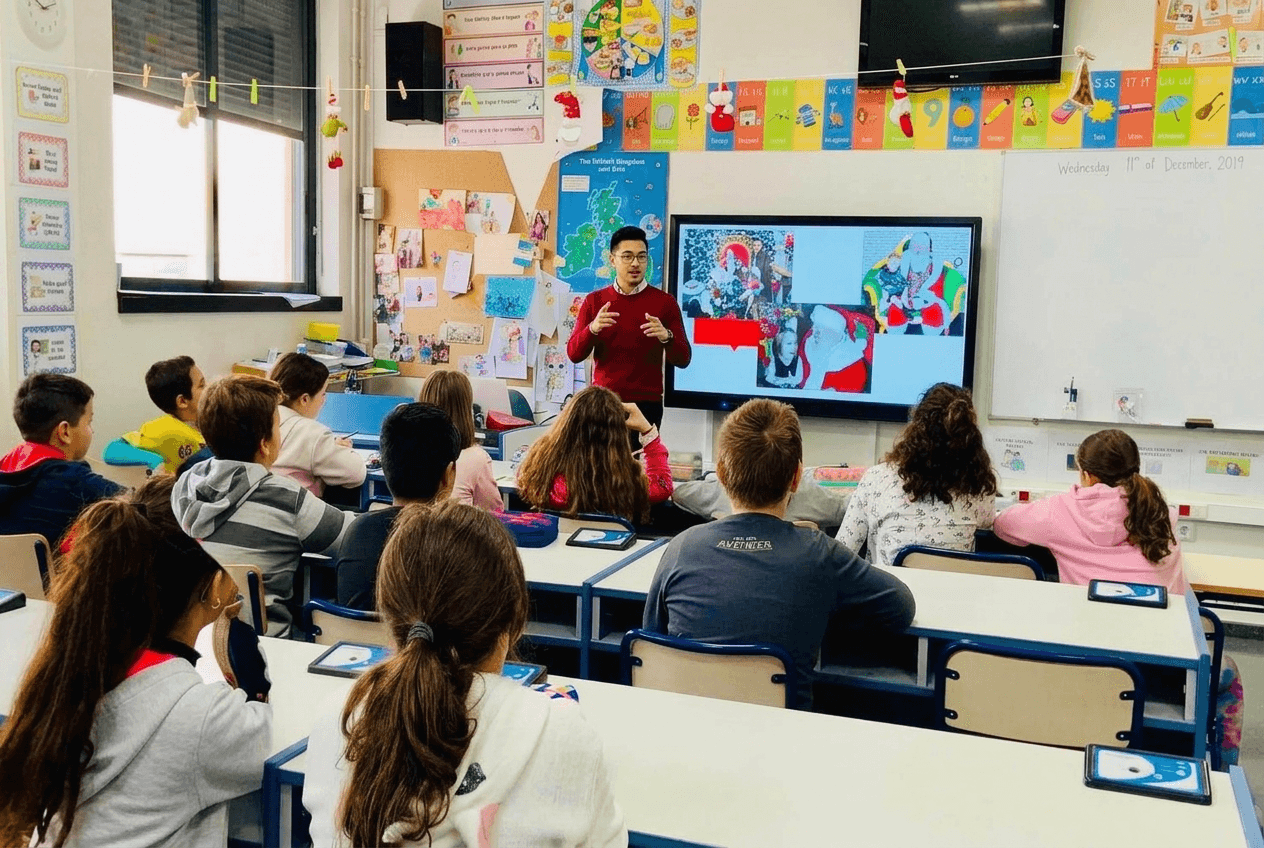
The course runs four weeks online. Monday through Wednesday are input sessions — theory, methodology, classroom techniques. Thursday and Friday are teaching practice.
That teaching practice component is one of the reasons Trinity holds British Council recognition. You don't just learn about teaching. You teach. In front of students. With a tutor observing and grading you.
Each teaching practice session puts you in front of five to ten students of varying nationalities. You're the only teacher in the room. You plan, deliver, and manage the class — and then receive structured feedback on your performance. Your pluses, your areas to improve, and your next steps.
You also teach both adults and children. The Teaching English to Young Learners (TEYL) component is built into the course, which matters because the children's English market in Spain is enormous and shows no signs of slowing down. Teachers who can do both adults and TEYL rarely run out of work.
And because the course is online, you graduate with two skills: teaching in person and teaching digitally. Tita mentioned that when COVID hit, EBC had to transition 200–300 pending students to online delivery. She said those graduates later told her it was one of the most valuable things that happened to them — because they came out knowing how to teach in both formats, which doubled their marketability. You also come out knowing how to use Zoom properly — breakout rooms, screen sharing, tools most people never actually learn.
One last thing Tita said that we hadn't considered: the skills you develop here aren't confined to English teaching. The fundamentals of how to explain something clearly, how to hold a room, how to manage different learning styles — those transfer directly into online course creation, content education, coaching, and anything else where you're trying to teach something to someone. It's a teaching credential that happens to be structured around English.

The Admission Process: Why Not Everyone Gets In
Something that surprised us — and reassured us — about EBC is that they don't accept everyone who applies.
After you submit your application, you're invited to a spoken interview. About 25 minutes, roughly eight questions. Nothing tricky — your work background, your educational experience, why you want to teach. What they're assessing is your spoken English level.
Then comes the 200-word handwritten essay. The topic is always the same: what makes a good teacher. You write it in front of the interviewer. The point isn't to test your knowledge of pedagogy. It's to verify your written English.
You need to be at C1 level — what used to be called advanced — to be accepted. Native English speakers qualify automatically on that measure, but they still go through the interview and essay process. Tita's explanation for why: speaking a language and teaching a language are not the same thing. She gave us an example that stuck.
Take these two sentences: "I used to live in San Francisco" and "I lived in San Francisco." Both are grammatically correct. Both are past tense. But they're not the same — and a Spanish student in your class, whose grammar instruction is typically quite rigorous, will eventually ask you to explain the difference.
The Trinity course doesn't teach you English grammar. It teaches you how to teach English grammar. How to explain the distinction above in a way that a non-native speaker can understand and use. That's what the admission process is checking for: not whether you can speak the language, but whether you have the level to learn how to teach it.
The Worldwide Lifetime Job Placement Service
Every EBC Trinity CertTESOL graduate gets this — included in the €1,450 course price.
After you graduate, you tell EBC where you want to teach and when. They forward your CV to their partner language schools in your chosen city. In Madrid alone, they have 385 partner schools. Across their network, 2,351 schools in countries where their graduates currently work.
You also receive a spreadsheet showing every school that received your CV — so you can reach out proactively rather than waiting to be contacted.
EBC is not an employment agency. They don't negotiate your contract or handle your hiring. But they put you in front of the schools, and from there, the interviews move quickly. Tita said it's not unusual for graduates to land a job within the first week.
And they stay involved. She told us about a graduate whose language school was paying €16 an hour when the agreed rate was €18. The graduate reported it to EBC. EBC called the school. When the school pushed back, EBC removed them from the database. Within two weeks, the school came back and resolved the issue — because without EBC's graduate flow, they couldn't find qualified teachers.
That's not a service you get from a $30 online course.
The network also gets vetted continuously. Schools are checked regularly to confirm they still exist and are operating well. If a school stops meeting EBC's standards, they come out of the database. The schools that remain are the ones that have proven they treat teachers well.

The Road to Spain: The Complete Pathway for People Who Want to Live Here
The four-week Trinity CertTESOL alone is powerful. But Tita introduced us to something that goes further — specifically designed for people who want to move to Spain using a student visa.
It's called The Road to Spain.
Here's how it works.
Step 1: Complete the Trinity CertTESOL (Online, From Home)
You do the four-week course before you leave your home country. This is deliberate. Tita's reasoning: while you're completing the course, you're not earning. Do it at home, where you're not paying Spanish rent. Arrive in Spain already certified and ready to teach from day one.
Some schools in EBC's partner network also conduct interviews remotely — which means you can have job conversations lined up before you even board the plane.
Step 2: Choose a Postgraduate Specialist Area
EBC offers three postgraduate tracks:
Brand Management
International Communications
Logistics
You choose one. This postgraduate program is what makes you eligible for a student visa to Spain.
Step 3: Apply for Your Spanish Student Visa from Home
With your EBC enrollment letter (the "letter of invitation") confirming your postgraduate enrollment dates, you apply for a one-year student visa at the Spanish consulate in your home country.
This letter is critical. Without enrollment in a physical, in-person program in Spain, the consulate will not issue a student visa. An online certificate alone won't get you there. The postgraduate program is what makes the visa possible.
Step 4: Arrive in Spain and Start Your Daily Routine
A typical day for a Road to Spain student looks like this:
9:00–12:00 — Spanish language classes
1:30–6:00 — English teaching (corporate and business classes, then children's classes in the afternoon)
6:30–8:30 — Postgraduate studies (in-person or online sessions)
On the student visa, you're permitted to work up to 30 hours per week. Most teachers earn between €1,500–€1,800 per month within that 30-hour limit. That's enough to cover rent, food, and daily life in most Spanish cities while you're studying.
The teaching schedule aligns with how Spanish companies use English classes: the lunch window (1:30–3:00) is prime time for corporate English classes, since Spanish companies often schedule language training during the long midday break. The afternoon window (4:30–6:00) fills with children coming home from school, university students, and students doing preparation for university entrance exams.
Step 5: Potential Visa Conversion
Here's where it gets interesting for people who fall in love with Spain — which, in our experience, is most people.
As you approach the end of your one-year student visa, language schools that are happy with your work have the option to sponsor you for a work visa. In Spain, to hire someone on a work contract, the employer must provide a proper employment contract and pay Social Security contributions. Schools that want to retain a good teacher have every financial incentive to sponsor the conversion.
Tita was careful here — she said this isn't guaranteed, it's case-by-case, and it depends on your performance and your relationship with the school. But it happens regularly. And EBC knows from the inside how this works, because they are also a language school and they've done it themselves.
The Five Documents You Need for a Spanish Student Visa
This came up in detail during our conversation. Every non-EU national needs these five things, regardless of nationality:
1. Financial Documentation The Spanish consulate requires evidence of €10,000–€13,000 in a bank account — but not as a one-time deposit. They need to see an account that shows regular financial activity over time: paychecks, transfers, rental income. The account has to demonstrate financial continuity, not a last-minute deposit before your appointment.
2. Private Medical Insurance Must be from a company recognized in Spain — meaning Spanish hospitals can work with them directly. Must include repatriation coverage.
3. FBI Report (or NBI for Filipinos) A national-level criminal background check, not a local one. Must be clean. Tita was emphatic on this: even a single DUI is enough for the consulate to decline the application. They are strict.
4. Medical Certificate A letter from a doctor or hospital confirming you are in good health.
5. Letter of Invitation / Enrollment Confirmation The letter from EBC confirming your postgraduate enrollment dates. This document is what tells the consulate why you need a student visa and for how long. Without it, there is no student visa.
Pricing: What the Programs Actually Cost
Tita shared the pricing openly during our conversation, so we're sharing it here.
Trinity CertTESOL Only (Standalone): €1,450 — includes the four-week online course, dual certification (TEFL + TESOL), certificate shipping to your location, and worldwide lifetime job placement service.
Road to Spain — Postgraduate + Student Visa + Trinity CertTESOL: €5,400
Road to Spain — Postgraduate + Student Visa (without Trinity CertTESOL): €4,450
The Spanish language program is optional within the Road to Spain pathway, but Tita's recommendation was clear: take it. If you arrive in Spain without Spanish, your options are limited to English teaching. The Spanish classes — offered partially online before you arrive and partially in person once you're here — are what open the door to eventually transitioning into another sector. And that transition is what most people are ultimately aiming for.
Who Is This For?
Tita described their student profile as diverse in a way that surprised us. Ages 18 to 68. Their oldest recent graduate was a 68-year-old British managing director from the petroleum industry who completed the course and loved it.
Most students fall into these categories:
Career changers — people who want to reset and build a different kind of life abroad
Aspiring expats — people researching every route into Spain and landing on this one as the most practical
Fresh start seekers — people who've closed a chapter and want to open a new one somewhere else
Returners to work — retired professionals with strong work backgrounds who want a second act, often using their decades of professional experience as a teaching asset
What draws them isn't necessarily a love of teaching. It's the combination: a recognized skill, a legal visa pathway, income while settling in, and a community that doesn't leave you alone once the course ends.
Watch the Full Interview with Tita Ashton
Everything above is the framework — the what and the how. But the conversation with Tita has texture that a blog post can't fully capture: the cowboy course story, the client who got underpaid and what EBC did about it, the question that she says stumps native English speakers every time, the 68-year-old managing director who finished the course and loved it.
She also talks through the Road to Spain in her own words — including specific advice on what to tell the consulate and what not to say during the student visa application.
If you're seriously considering this pathway, watch it before you do anything else.
▶ Watch the full interview with Tita Ashton of EBC Trinity CertTESOL [Link coming soon]
Connect with EBC Trinity CertTESOL
Find Tita and the EBC team at their website — the direct link is in the video description below. They respond to email inquiries and will walk you through the admission process and which program fits your situation.
Before You Go: Two Resources That Will Help You Figure Out Where in Spain to Land
You now know how to get to Spain legally and how to sustain yourself when you arrive. The next question — for most people — is where.
🇪🇸 The Spain City Guide — 50 Cities, Honest Breakdowns, Zero Hype
We covered 50 Spanish cities across four categories: the most popular expat hubs, the best mid-sized cities, the small towns worth knowing, and the hidden gems most people never find. Every city gets a real breakdown — climate, cost, expat community, trade-offs, and who it's actually right for.
Teaching English opens doors across the country. But Madrid and Barcelona have the deepest language school networks (Madrid alone has 385 EBC partner schools). Valencia, where we live, has a growing market. Knowing where to land before you apply makes the whole process cleaner.
→ Check out the Spain City Guide Mini-Course
🏠 The Apartment Hunting Guide — Find a Place Before You Arrive
Once you know the city, you need a place to live — and Spanish apartments operate nothing like what Americans or Filipinos are used to. This guide covers how to read listings, understand contracts, know your rights as a tenant, and decide whether to use a relocation agent or go it alone.
Disclaimers
Not Professional Advice: Nothing in this post constitutes legal, immigration, financial, or career advice. All information is for general educational purposes based on a recorded interview with a third-party program provider. Individual results, visa outcomes, and employment timelines will vary based on your personal circumstances, nationality, financial situation, and the specific requirements of the Spanish consulate serving your home country. Always consult a licensed immigration attorney and the official Spanish consulate in your jurisdiction before making any visa or relocation decisions.
Program Information May Change: Pricing, program structure, visa requirements, financial documentation thresholds, and partner school networks are subject to change at any time. The information shared here reflects what was accurate at the time of our conversation with EBC Trinity CertTESOL. Verify all details directly with EBC and your Spanish consulate before enrolling or applying.
Endorsement: Our mention of EBC Trinity CertTESOL, Tita Ashton, or any affiliated programs reflects our personal experience with this interview. It constitutes as a formal professional endorsement but doesn't guarantee of outcomes. Do your own research before enrolling in any certification program or educational pathway.
Third-Party Program: EBC Trinity CertTESOL is an independent organization. We are affiliated with, and financially compensated but not employed by EBC for this content at no cost to you. All opinions shared in this post and the accompanying video are our own.
Published by Everything is Boffo. We are Filipinos who left Southern California, moved to Valencia, and became Spanish citizens. We share our experiences to help others considering the same path — not as licensed professionals, but as people who've lived it.

Hello, we're Bea and Paul…
...and we know exactly what it’s like to chase that better life. We spent 13 years working hard in Southern California, but after wrestling with one immigration hurdle after another, we realized that the "American Dream" wasn't quite working out for us. So, we sold everything, packed our bags, and moved to Spain—site unseen!
Our YouTube channel, Everything is Boffo (Life in Spain), tells the whole crazy story, from our first jamón to navigating our own residency here. We share the realities of life in Spain, the slow travel, the good food, and how we make it all happen.



Disclaimer: This content is provided for general informational and educational purposes only and should not be considered legal, financial, tax, medical, or immigration advice. Rules, visa requirements, housing regulations, tax obligations, and public services in Spain can change frequently and may vary depending on your nationality and personal circumstances. Always verify information with official government sources or qualified professionals before making decisions. Some links, resources, courses, consultations, and recommended services mentioned throughout our content may be affiliate partnerships, meaning we may earn a commission at no additional cost to you if you choose to use them. We only share resources, professionals, and services we genuinely trust or believe may be useful to our community. Any opinions expressed are our own and based on personal experience, research, interviews, and publicly available information at the time of publication.
Support from readers who use our links, courses, or resources helps us keep this information free, maintain the platform, and quite literally keep the lights on at home so we can continue producing guides like this for the community.
Newsletter
Subscribe now to get the latest updates.
Created with © systeme.io