How to Bring Your Foreign Spouse, Children or Parents to Spain as a Spanish Citizen (2026 Guide)
How to Bring Your Foreign Family to Spain as a Spanish Citizen (Complete 2026 Guide)
You got the Spanish passport. Now what happens to everyone else?
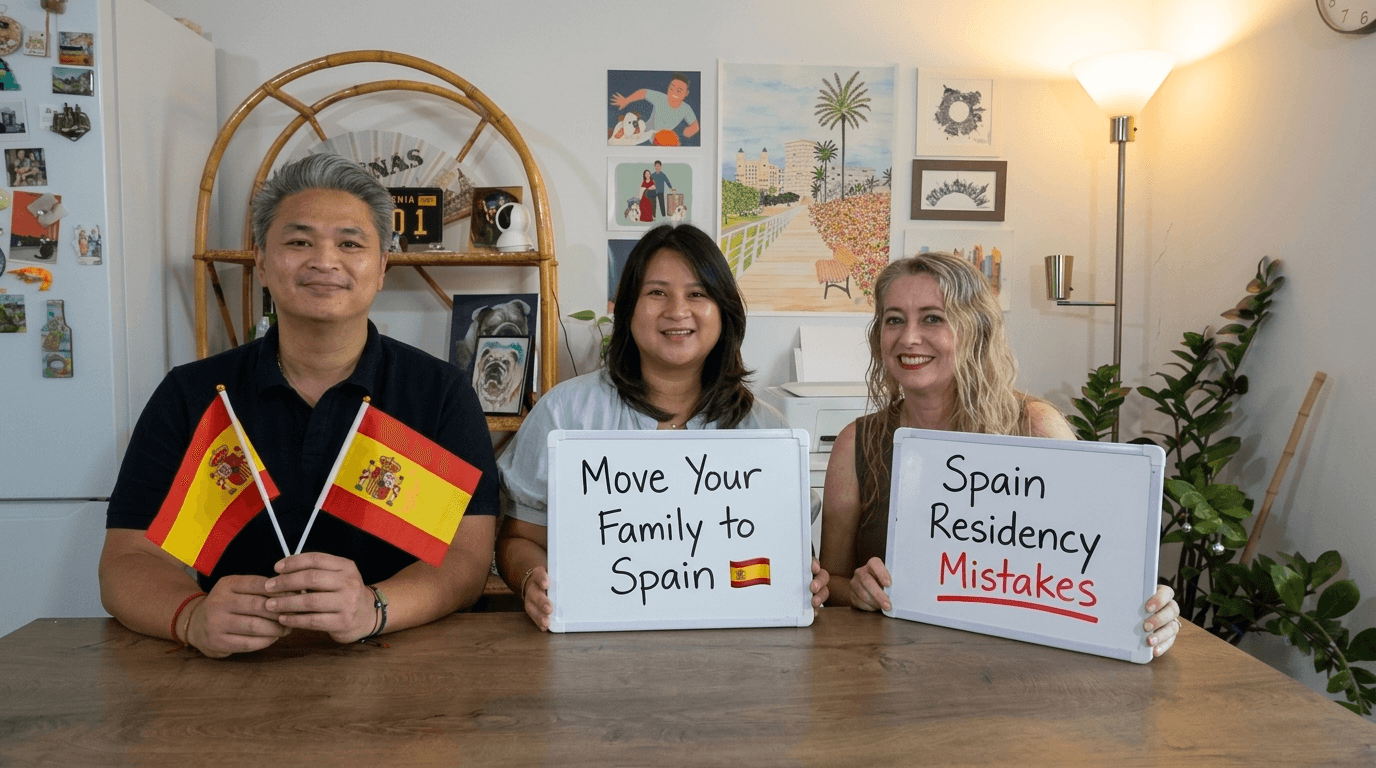
Getting Spanish citizenship is one thing. Figuring out what happens to your family — your spouse, your kids, your parents — is a completely different conversation. And it's one most people don't have until they're already in the middle of it.
We sat down with Maria Muñoz, a relocation specialist based in Spain who has spent five years helping families from the US, UK, Philippines, and beyond navigate exactly this situation. Maria is Spanish herself. She lived in the UK for 21 years, her husband is British, and her children were born in England. When she moved back to Spain before Brexit, she went through this process firsthand — and then watched everyone around her at the British school ask her the same questions she'd just figured out.
That's how her business started. A Facebook page. A few people asking about NIE numbers and Padron. And then it grew into everything: non-lucrative visas, EU residency, digital nomad visas, driver's license exchanges, and the one we're focusing on today — the process of bringing your non-Spanish family to live in Spain when you hold a Spanish passport.
This is the complete guide. But the honest detail — the client stories, the mistakes, the moments Maria described that made us stop and take notes — is in the video. Watch it before you start any of this process.
First, Let's Define the Situation
This guide is specifically for people who:
Are Spanish citizens (either born Spanish, obtained citizenship through residency, or obtained it through the Ley de Memoria Democrática)
Have family members — spouse, children, or parents — who are not Spanish
Want those family members to live with them in Spain legally
This situation applies to a lot of people reading this. Filipino-Americans who obtained Spanish citizenship and now want to bring their American or Filipino spouse. Americans who went through the residency process and became citizens and now want their family to join them properly. Maria's own story — a Spanish woman who came home from the UK with a British husband and British-born children.
The process for all of them runs through the same system. Here's how it works.
What Is the Tarjeta de Familiar de Español?
Until recently, this was called the Arraigo Familiar. The Spanish government renamed it — it's now officially called the Tarjeta de Familiar de Español.
This is the residence permit that allows the non-Spanish family members of a Spanish citizen to live legally in Spain. It's not a visa. It's a residency card. And the distinction matters, because the requirements and the rights it grants are different from visa routes.
What makes this route genuinely attractive:
No income or financial requirements — unlike the Non-Lucrative Visa or the Digital Nomad Visa, you don't have to prove a minimum income. The Spanish government just needs to know you're really a family.
Work rights are granted almost immediately — more on this below.
Children are entitled to education from the moment they arrive, regardless of residency status.
The residency lasts five years and can be renewed to permanent residency.
Maria called it one of the more accessible routes she processes — but she was clear that "accessible" does not mean "simple." The paperwork is real, the timing is critical, and the wrong document on the wrong date can send you back to the start.
Who Counts as "Family" Under This Process?
This question came up in our conversation with Maria and it's worth being specific, because people often assume more than the law covers.
Who qualifies without conditions:
Your spouse or registered partner
Your minor children
For these family members, you just need to prove the relationship. Marriage certificate, birth certificates. That's the core of it.
Who qualifies with conditions:
Your parents — they qualify, but you have to prove they are financially dependent on you. Not a specific dollar amount — just documented evidence that you are supporting them. Bank transfers, paying their rent or mortgage, something concrete that shows they need your financial help. Maria noted one important exception: if your parents are over 80 years old, Spain essentially waives the financial dependency requirement. The logic is that at that age, they're likely dependent on you in other ways — physically, practically — and the government acknowledges that without requiring proof.
Who does not qualify:
Siblings. Even adult siblings who are close to you don't qualify under this route. Maria checked on this during our conversation — she hadn't seen that specific case before — but confirmed that adult siblings without financial dependency don't fall under the direct family definition. If your sibling is a minor, it gets more complicated; if you're uncertain, ask Maria's team directly.
The Documents You Need — And Why Timing Is Everything
Maria said something in our conversation that should be written at the top of every document checklist you find online:
"Timeline is critical in all these processes."
Every document has an expiry date. A criminal records check issued six months ago won't work. A marriage certificate that isn't freshly obtained won't be accepted. You can't just gather everything in advance and wait — you need to know the order of operations, understand which documents have 90-day windows, and work backwards from your planned move date.
Here is the core document list for the Tarjeta de Familiar de Español:
For adults (spouse, parents):
Criminal records check from your country of residence — must be apostilled and sworn translated. This document has a validity window. Get it close to when you need it, not months in advance.
Marriage certificate — Maria was explicit about this one: get a new one. A marriage certificate dated "as of today" tells the Spanish government you are still married. An old one doesn't do that clearly enough.
For children:
Birth certificates — apostilled and sworn translated
Libro de Familia — this can be obtained at a Spanish consulate in your home country
Registration in the Registro Civil in Spain — this is a critical step that many people miss
For everyone:
Padron (municipal registration) — more on why this one is a headache below
The Spanish citizen's passport
Where to find the official list:
The full requirements are published on the Spanish government website. Maria recommends checking the Spanish consulate in your home country first — in some cases they can assist with parts of the process before you leave. The link to the government portal will be in the video description.
The Padron: Simple in Theory, Complicated in Practice
The Padron is Spain's municipal registration system. When you rent a long-term property or own a home in Spain, you go to your local town hall (ayuntamiento) and register. That registration — the Padron — is how you prove to Spanish institutions that you actually live where you say you live.
It's required for the residency process. It's required for the driver's license exchange. It's required for healthcare registration. It is, in Maria's words, something that "should be very simple."
And sometimes it is. Sometimes you walk in and get it the same day.
Other times — and this is what Maria described in the video with a specific client in Córdoba — it takes six months. The client arrived in Spain in December. They went to the town hall, did everything correctly, and as of nearly June still hadn't received the Padron. The driver's license appointment was scheduled. The medical was done. Everything was ready — except the Padron that the town hall simply hadn't processed.
There's no national standard for how quickly it's issued. It varies by city, by time of year, by how busy that particular office is. Larger cities — Madrid, Barcelona, Alicante — tend to be backed up. Smaller municipalities can be surprisingly fast.
Maria's practical advice: show up in person, early, before the office opens, and wait in line. You're more likely to get it processed same-day if you're physically there. Don't rely solely on appointments through the portal.
The Step-by-Step Process: How It Actually Unfolds
Here is the complete sequence from the moment a Spanish citizen decides to bring their family to Spain:
Step 1: Plan Before You Board the Plane
Maria's first instruction to every client is the same: do not arrive in Spain and then figure it out.
The moment a non-Spanish family member enters Spain as a tourist, the 90-day clock starts running. If you're mid-application when those 90 days expire, you are essentially stuck in Spain until the residency is approved — because leaving and coming back resets the clock in a way that complicates the process. Maria told us she's had to explain to frustrated clients that yes, being stuck in Spain is not the worst problem to have, but it's still a real logistical constraint.
Gather your documents before you leave. Understand the process. Know the timeline. The consulate in the Philippines, the US, or wherever you're coming from may be able to assist with some steps in advance.
Step 2: Get the Padron First
Once you arrive and have a confirmed address (rental contract or property ownership), register for the Padron at your local town hall immediately. Don't wait. This document is a dependency for almost everything else, and as we've established, it can take time you don't have.
Step 3: Get Your NIE (If You Don't Have One)
Every person in Spain — citizen or not — needs an identification number. For Spanish citizens, this is the DNI (Documento Nacional de Identidad). For non-Spanish residents, it's the NIE.
Before the Tarjeta de Familiar de Español application is submitted, your non-Spanish family members will need their NIE numbers. This is also handled through the Spanish government system.
Step 4: Submit the Application Online
The Tarjeta de Familiar de Español application is submitted through an online portal. Maria handles this for her clients — she uploads all the documents, submits the application, and manages the portal communication.
After submission, you receive a communication (a downloadable letter from the same portal) confirming that the application has been received. That letter typically arrives anywhere from the next day to a few weeks after submission. And critically — that letter states that the applicant is authorized to work. This is before any approval, before any physical card. The authorization to work comes with the acknowledgment of application.
Step 5: Wait — Patiently
The stated processing time is roughly two months for this particular residency, which is faster than most other visa routes (which tend to run three months). In practice, Maria has seen it take up to five or six months depending on the city.
Madrid and Barcelona tend to be slower because of volume. Other provinces can be faster. There's no way to guarantee it.
Maria's strategy when the timeline runs long: she sends a letter through the online portal — essentially a formal nudge to the case handler — after three months have passed. She says it works. Not immediately, but it gets the application looked at again. She may need to send it more than once.
Step 6: The TIE Card
After approval, the family member needs to get their TIE — the physical residency card (Tarjeta de Identidad de Extranjero). This requires a separate appointment. Add roughly another month to the timeline for this step.
Once the TIE is in hand, healthcare access activates. The family member can register as a beneficiary of the Spanish citizen and access Spain's public health system.
Rights Your Family Gets Under This Residency
This is one of the parts of the conversation with Maria that genuinely impressed us. The Tarjeta de Familiar de Español grants real, meaningful rights:
Work: Authorized from the moment the application is acknowledged — before approval, before the card. The communication letter is the document that proves it.
Education: All children in Spain are legally entitled to a school place regardless of their residency status. This is national law. No exceptions.
Healthcare: Once the TIE card is issued, family members become beneficiaries of the Spanish citizen and access the public health system. Note: this is tied to having the Padron registered and the TIE in hand. Healthcare is based on residency, not just nationality.
Duration: The initial permit is for five years. After five years, it renews to permanent residency.
Path to citizenship: After holding permanent residency, family members can pursue Spanish citizenship through the standard residency-to-nationality route.
What About the Children's Citizenship?
This is something we didn't know before our conversation with Maria, and it might surprise you too.
If you are a Spanish citizen and your children were not previously registered in Spain's civil registry — meaning they didn't already have Spanish citizenship — there is a one-year waiting period before they can become Spanish citizens after you obtain your passport.
You can't get your Spanish citizenship in January and have your children's Spanish passports by March. The government requires you to have held the citizenship for a year before your children can access it.
Maria's own story illustrates the alternative: because she was already registered in the Spanish civil registry when she returned to Spain, her children could claim Spanish citizenship through her without the one-year wait. The difference is being "already in the system" vs. newly obtaining the passport.
If you're recently minted as a Spanish citizen through the Ley de Memoria Democrática or through residency — plan for that year. Your children can live in Spain on the Tarjeta de Familiar de Español in the meantime. They won't be without legal status. But the Spanish passport for them comes after the year.
The DNI: Your First Task After Arriving as a Spanish Citizen
One more thing Maria covered that trips people up: if you're a Spanish citizen who has never lived in Spain before, you likely don't have a DNI (the Spanish national identity number).
Getting your DNI requires a specific letter from the Registro Civil (Civil Registry). And here's where it gets specific: it can't just be any letter from the Registro Civil. It has to be a letter that explicitly states it is for the purpose of a passport and DNI. The standard Registro Civil letter won't work. Maria went through this herself — she arrived at the appointment with the wrong letter, was turned away, and had to start the appointment process again.
You can do the Registro Civil registration from outside Spain (through the consulate in your home country). But to get that specific letter for the DNI, you need to be in Spain and either have a digital certificate to access the system online or book an in-person appointment.
Get this done first. The DNI is tied to everything — your bank account, your utility bills, your phone contract, your tax number. Without it, you're an alien in your own country. Maria still laughs about the first year she was back in Spain after 21 years abroad, not knowing her DNI off the top of her head — and the looks she got from shop workers and bank staff who couldn't comprehend a fluent Spanish speaker who didn't know their own national ID number.
Driver's License Exchange: One More Piece of the Puzzle
This came up briefly in our conversation and it's worth flagging for people in this situation.
Spain has agreements with certain countries that allow residents to exchange their foreign driver's license for a Spanish one without taking the full Spanish driving test — the so-called canje. Countries that have this agreement include the UK (despite Brexit, they retained the exchange agreement), the Philippines, and various South American countries.
The rule: you have six months from when you become a resident to do the exchange. After that, legally you should not be driving on your foreign license.
For anyone going through the Tarjeta de Familiar de Español process, put the driver's license exchange on your list. It's one more appointment, one more document, one more piece of timing to track — but it's much easier to handle early than to deal with later.
What to Do Before You Watch the Full Video
If you're reading this and you're in this exact situation — Spanish citizen, non-Spanish family, trying to figure out how to make this work — here's what Maria recommends before you do anything else:
Don't arrive in Spain without a plan. The 90-day tourist window starts running from the moment your non-Spanish family member enters.
Start the document gathering in your home country. Criminal records check, marriage certificate, birth certificates — all need apostilles and sworn translations. Some of this can start before you buy the ticket.
Register for the Padron the day you have an address. Don't wait.
Be mindful of document expiry dates. A criminal records check from 6 months ago is not the same as a fresh one.
Talk to someone who has done this before. Maria offers consultations specifically for situations like these — whether you're a Spanish citizen trying to bring your American spouse, or a Filipino with a new Spanish passport trying to figure out the right order of operations.
Watch the Full Conversation With Maria
Everything above is the framework. But the real texture of this process — the specific client stories, the Córdoba Padron nightmare, Maria's own experience moving back to Spain with British kids and a British husband and a DNI she'd never memorized — that's all in the video.
Maria also covers the Digital Nomad Visa, the Non-Lucrative Visa, EU residency for non-EU family members, and the nuances that change depending on where you're coming from. If you're anywhere in the moving-to-Spain process, this conversation is worth your time.
▶ Watch the full interview with Maria Muñoz — everything about bringing your family to Spain legally
Connect with Maria Muñoz
Maria Muñoz and the Help At Hand Spain team work with families navigating Spanish residency, visas, driver's license exchanges, and relocation logistics across the country.
Find her at helpathandspain.com — and mention you came from this video.
Before You Go: Two Resources That Will Help You Decide Where in Spain to Land
You now know how to bring your family legally. The next question — for most people reading this — is where.
Spain is not one place. It's 50 cities with completely different climates, costs, cultures, and expat communities. The Spain your family settles in will be shaped by that choice, and it's worth making it with real information.
🇪🇸 The Spain City Guide — 50 Cities Covered, Zero Hype
We spent a long time comparing Spanish cities before we chose Valencia. And then we built a mini-course so you don't have to spend as long doing the same.
50 cities across four categories — the most popular expat hubs, the best mid-sized cities, the small towns worth knowing, and the hidden gems most people never find. Every city gets an honest breakdown: the real expat experience, the climate, the cost of living, the trade-offs, and who it's actually right for.
→ https://www.everythingisboffo.com/city-guide
🏠 The Apartment Hunting Guide — Find a Place Before Your Family Arrives
Once you know the city, you need a place to live — and Spanish apartments work nothing like what Americans or Filipinos are used to. This guide covers how to read listings without getting misled, the vocabulary you need for contracts, who handles repairs, and whether to hire a relocation agent or go solo.
It's the guide we wish we had when we were figuring this out from California.
This post is based on our recorded interview with Maria Muñoz of Help at Hand Spain. All information is provided for general educational purposes only and does not constitute legal advice. Spanish immigration law and residency requirements change frequently — always consult a licensed professional for your specific situation.
Disclaimers
Not Legal Advice: Nothing in this post constitutes legal, immigration, or financial advice. The information shared is for general educational purposes based on a recorded interview with a third-party relocation specialist. Every family's situation is different. Before making any immigration or residency decisions, consult a licensed Spanish immigration attorney or accredited specialist in your home country and in Spain.
Accuracy and Changes: Spanish immigration law, residency requirements, processing times, and document requirements change regularly. While we have made every effort to ensure accuracy at the time of publication, we cannot guarantee this content reflects current law or policy. Always verify critical details with a licensed professional before acting on anything in this post.
Published by Everything is Boffo. We are Filipinos who left Southern California, moved to Valencia, and became Spanish citizens. We share our experiences to help others considering the same path — not as licensed professionals, but as people who've lived it.

Hello, we're Bea and Paul…
...and we know exactly what it’s like to chase that better life. We spent 13 years working hard in Southern California, but after wrestling with one immigration hurdle after another, we realized that the "American Dream" wasn't quite working out for us. So, we sold everything, packed our bags, and moved to Spain—site unseen!
Our YouTube channel, Everything is Boffo (Life in Spain), tells the whole crazy story, from our first jamón to navigating our own residency here. We share the realities of life in Spain, the slow travel, the good food, and how we make it all happen.



Disclaimer: This content is provided for general informational and educational purposes only and should not be considered legal, financial, tax, medical, or immigration advice. Rules, visa requirements, housing regulations, tax obligations, and public services in Spain can change frequently and may vary depending on your nationality and personal circumstances. Always verify information with official government sources or qualified professionals before making decisions. Some links, resources, courses, consultations, and recommended services mentioned throughout our content may be affiliate partnerships, meaning we may earn a commission at no additional cost to you if you choose to use them. We only share resources, professionals, and services we genuinely trust or believe may be useful to our community. Any opinions expressed are our own and based on personal experience, research, interviews, and publicly available information at the time of publication.
Support from readers who use our links, courses, or resources helps us keep this information free, maintain the platform, and quite literally keep the lights on at home so we can continue producing guides like this for the community.
Newsletter
Subscribe now to get the latest updates.
Created with © systeme.io